
- ✓Category-leading, photorealistic image generation
- ✓Strong visual consistency across generations
- ✓Deep character customization and a large library
- ✓Permissive roleplay that rarely breaks character
- ✓Above-average adaptive voice with nine profiles
- ✓Cheap base subscription, especially billed annually
- ✓Discreet "Everai" billing plus crypto payment options
- ✓Legitimate, scan-clean business with GDPR obligations
In-depth reviewHighly Recommended10 min read · Last updated Aug 26, 2026
Candy AI Review 2026: The Real Cost, the Memory Wall, and Whether It's Worth It
What Candy AI gets right, where the cracks appear, and how to decide if it fits your use case.

Lena Voss
Independently reviewed · Fact-checked
Quick Verdict
Candy AI is a capable, visually strong companion platform that's genuinely good at image consistency and roleplay. It's a reasonable pick if you're mostly a text-and-occasional-image user on the annual plan. It's a weaker choice if you want heavy image, voice, or video use, because the token system can push your real cost well past the advertised subscription price. Billing transparency is the single most common complaint against it.
8.2
Candy AI is one of the most talked-about AI companion platforms heading into 2026, and the conversation around it is unusually split. Some users call it the most polished AI girlfriend app on the market.
Others describe a billing structure that quietly turns a cheap subscription into a far larger monthly spend. Both things appear to be true at once, which is exactly why a careful look is worth your time before you enter card details.
This review consolidates what the platform officially offers, its actual pricing after you utilize the features it encourages, and what hundreds of real customers report on independent review platforms.
We've weighed the genuine strengths against the recurring complaints rather than landing on a one-line verdict, because the right answer here depends heavily on how you plan to use it.
Where Candy AI fits for you, where it falls short, and a strong alternative worth comparing it against are all covered below.
By the end you'll know whether the subscription makes sense for your specific use case, or whether your money is better spent elsewhere.
Candy.ai Review Summary
Across our testing we rated seven things that actually decide whether a platform is worth joining. Here is how Candy.ai landed on each one.
What we tested | Score | What we found |
|---|---|---|
AI conversation quality | 9.0 | Natural, in character, and the main reason to pay |
User interface | 9.0 | The cleanest, most polished design we tested |
Character customization | 9.0 | Deep control over looks, personality, and backstory |
Photo and image quality | 7.5 | Stunning at best, inconsistent at worst |
Value for money | 7.5 | Fair subscription, but tokens push the real cost up |
Privacy and safety | 8.0 | Discreet billing, but chats are stored not encrypted end to end |
Mobile experience | 8.0 | Web app works well, no native app needed |
SpicyRanked Score | 8.3 | The most complete AI companion you can buy right now |
Why You Should Trust This Review
This review is written and edited by the SpicyRanked team, which covers AI companion platforms full time. Our work in this category means we evaluate these tools against the same consistent criteria every time, rather than reacting to whichever feature a platform happens to be marketing this month.
Every factual claim here is grounded in primary sources and verifiable user sentiment, not recycled from other review pages. Pricing, features, and policies are checked against the platform's own live documentation, and every criticism is drawn from documented user reports across independent review platforms rather than presented as an unsupported opinion.
Where the available information is inconsistent, such as the platform's reported corporate jurisdiction, we say so plainly instead of picking the tidiest answer.
We also keep this review current.
Pricing and token costs in this category shift often, so the figures here reflect our most recent check, and the date at the top of the page tells you exactly how fresh that is.
Our aim is a balanced, decisive verdict you can act on, not a sales pitch dressed up as a review.
How We Research Our Reviews
Our review process follows the same structure for every platform we cover, so the conclusions are comparable across the category rather than one-off impressions.
We start with the official source. Features, plan structure, token costs, payment methods, and policies are taken from the platform's own pages and help documentation first, because that's the most reliable record of what's actually on offer, and we treat the live checkout page as the final word on price.
From there we analyze real user sentiment at scale.
We read across independent review platforms, consumer-complaint records, and community discussion to identify the patterns that recur often enough to be meaningful, separating one-off frustrations from systemic issues like the billing and memory themes documented later in this review. Positive and negative signals are both weighted, so the result reflects the full picture rather than the loudest voices.
Finally, we model the real cost.
Rather than quoting only the headline subscription price, we map the token system onto realistic usage patterns to show what light, moderate, and heavy users actually spend each month.
That cost modeling is the part most reviews skip, and it's where the gap between the advertised price and the true price becomes clear.
What Is Candy.ai?
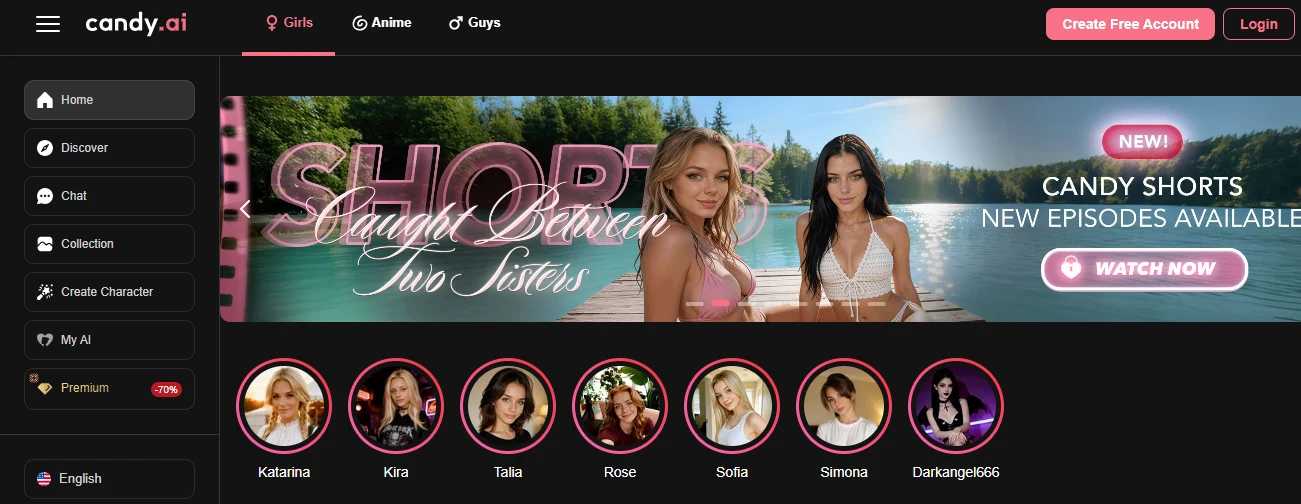
Candy.ai is an AI companion platform where you create a virtual partner and then talk to them through text chat, AI generated photos, and voice messages.
You can pick a ready made character from a gallery or build your own from scratch, choosing the looks, personality, interests, and backstory. Everything runs in your browser, so there is nothing to download, and setting up an account takes about two minutes.
The whole product is built around one idea, connection that feels personal. A normal chatbot answers questions and forgets you the moment you close the tab. Candy.ai is designed to do the opposite.
Your companion remembers details about you, keeps a consistent personality, and shifts tone based on how you talk to them. That sense of continuity is the entire appeal and the reason people keep logging back in.
It is also worth being clear about what Candy.ai is for. This is not a productivity tool or a study helper. It is built for companionship, roleplay, flirting, emotional comfort, and adult content.
The platform is upfront about that, and explicit interaction is a core part of the experience rather than something bolted on. You can toggle that content on or off depending on what you want.
When Was Candy.ai Launched and Who Owns It
Candy.ai launched in 2023 and is owned and operated by EverAI Limited , a company registered in Malta. The domain itself dates back to 2017, but the AI companion product as people know it today went live in 2023 and scaled quickly into one of the biggest names in the category.
The company is led by CEO Alexis Soulopoulos , who previously co-founded the Australian pet sitting platform Mad Paws and took it all the way to a public listing.
He is joined by a founding team with serious startup track records, including co-founder and CTO Michael Monin and co-founder and CMO Thomas Lacroix, both serial entrepreneurs with prior exits behind them.
EverAI runs as a real, staffed business with dozens of employees, not a one person side project. That matters, because in a space full of fly by night sites, knowing there is an identifiable company and a named leadership team behind the product is a genuine trust signal.
How Big Is Candy.ai?
Candy.ai grew fast, and the numbers back up the hype. According to Similarweb traffic analytics , the site pulled in roughly 39.3 million visits in April 2026, with an average of more than three pages per visit.
This data also shows the user base is about 82% male and 18% female , with the largest group aged 25 to 34 , and the United States, India, and Brazil sending the most traffic.
In plain terms, this is a mainstream scale platform with a global audience, not a niche curiosity.
Candy.ai is also riding a fast growing market. Grand View Research valued the global AI companion market at 28.19 billion dollars in 2024 and projects strong double digit annual growth through the rest of the decade.
Separate analysis from Business Research Insights reports that around 33 percent of users now engage with an AI companion daily, which explains why a platform like Candy.ai can scale to tens of millions of visits a month.
Whatever the exact headline figure, the takeaway is the same. This is an established platform with a large, active user base and a team that ships regular updates.
It is not going to take your subscription and vanish next week. If you want the wider context on the category, our guide to the best AI girlfriend apps breaks down how Candy.ai stacks up against the rest of the field.
What Makes Candy.ai Different?
Two things set it apart. The first is conversation quality. Chats feel natural and hold character far better than most rivals manage, which is the single biggest reason it scores so well.
The second is that Candy.ai builds its own characters, including their looks and backstories, instead of leaning mostly on user uploads the way some competitors do.
Long term users point to this as the main reason they prefer it over apps like Replika or Nomi. The companions feel curated and coherent rather than thrown together.
Candy AI Features That Define the Experience
Candy AI's reputation rests on a handful of features that it does noticeably better than the category average, alongside a couple that are more divisive.
Here's what each one is actually like in practice.
1. Image generation: the strongest card
Image quality is where Candy AI separates itself. Reviewers consistently rate it as the sharpest in the space. The image output is photorealistic and, importantly, anatomically correct, without the extra fingers or misaligned features that plague weaker generators.
The system also handles context and lighting. A request for a photo at golden hour on a balcony reportedly returned warm light at the right angle, natural shadows, and a photographic depth of field, rather than the slapped-together look of lower-end AI art.
The pre-made gallery follows the same philosophy, favoring attractive but believable characters with subtle imperfections over uncanny-valley perfection.
Visual consistency is the technical differentiator underneath all of that. The same companion tends to look like the same person across many generated images, which competing platforms frequently fail to maintain.
A V2 image engine on select premium characters, marked with a badge in the library, produces sharper output and better prompt adherence than the standard tier.
The consistency isn't perfect, and it's fair to say so. In our assessment, while face consistency and lighting hold up well, specific outfit and setting requests land correctly only around half the time, so a request like wearing a particular dress from an earlier image hits maybe fifty percent of the time.
For image-heavy use, that miss rate means some wasted generations, and wasted generations cost tokens.
2. The character gallery
The gallery itself is a feature worth dwelling on, because it's where the platform first hooks most users. Browsing it feels like browsing a dating app, with each profile carrying a backstory, personality tags, and conversation starters rather than just a static image.
The design choice that stands out is restraint. Rather than filling the gallery with unsettlingly perfect supermodels that trip the uncanny valley, the characters reportedly read as attractive but believable humans, with the kind of subtle asymmetry and natural detail that makes them feel photographed rather than generated.
For users whose main draw is visual realism, that's the difference between immersion and a constant low-level reminder that none of it is real.
If the pre-made roster doesn't fit, the builder picks up the slack. Fine-tuning a custom companion can take close to forty-five minutes across a custom companion across physical attributes, personality sliders, and backstory fields, and reports the resulting conversations felt noticeably more aligned with those inputs. The depth is real, but it does ask for an upfront time investment to get the most out of it.
3. Story Mode and scene awareness
A 2026 Story Mode update adds automatic image generation timed to your roleplay narrative. Instead of manually requesting a picture, the platform reads the context of your conversation and offering visuals tied to the current scene.
It works best inside structured roleplay with clear setting descriptions, and produces odd results in abstract or humor-driven conversations because the system renders things literally. The takeaway is that the more specific and situational your prompts are, the more the feature pays off.
A concrete illustration: a vague opener like "let's talk" produces generic output, while a detailed scene, sitting in a bookstore café while it rains outside, reportedly anchors the companion in that setting and builds on it rather than drifting into small talk. Scene-setting is doing real work in how good the experience feels.
4. Conversation and memory
Day-to-day conversation quality is generally solid and adaptive. The memory system is one of the better implementations in the category, with companions recalling details you share across conversations rather than treating you like a stranger each session.
Conversation quality does vary by the personality preset you choose. The same review notes that certain archetypes, the more grounded ones, produce noticeably more natural dialogue than the heavily stylized presets, so the companion you build directly shapes how good the conversation feels.
After long sessions, the AI can drift into repetitive phrasing, which is a category-wide issue rather than something unique to this platform.
Memory is also the single most disputed aspect of the whole platform, and the gap between the marketing claim and the lived experience is wide enough that it gets its own dedicated walkthrough further down. It's the reason a lot of otherwise satisfied users eventually cool on the product.
One practical detail shapes how good the conversation feels day to day: prompt specificity. The companion responds far better to situational, detailed input than to open-ended openers, so the way you write to it has a direct effect on the quality of what comes back.
For NSFW roleplay specifically, the platform sits among the more permissive options in the category. The companion rarely breaks character or snaps back to a neutral, scripted tone the way more restricted tools do, which is a meaningful part of why users who prioritize uncensored interaction gravitate toward it.
The trade-off is the relationship-building pacing already noted, where explicit content unlocks after some conversational context rather than instantly.
5. Voice and video
Voice chat is better than the category usually manages. The platform offers nine voice profiles, with the warm and soft presets being the strongest and the more confident options carrying a subtle artificial edge over longer calls. The tone adapts to context, dropping quieter and more intimate during personal moments, which several users find genuinely affecting.
It isn't indistinguishable from a real human, and reviewers are candid that you can tell it's synthesized if you listen for it, but it's among the better implementations in this category.
Whether it's worth the token cost depends heavily on whether voice is a main feature or an occasional extra for you, which the cost section quantifies.
Short generated video clips round out the media features, including an option to convert a generated image into a brief video. These are the most token-expensive actions on the platform, so they sit at the heart of the cost conversation rather than off to the side.
Candy AI Review - Pricing & Tokens [WITH REAL NUMBERS]
This is the most important section in the review, because the distance between the advertised price and the real-world price is the source of nearly every billing complaint against Candy AI.
Most reviews gloss over it.
This one won't.
The platform has two separate cost layers that catch people off guard: the subscription, and the tokens.
The subscription covers unlimited text messages. Tokens cover everything else, meaning images, voice calls, video clips, and certain private content.
Subscription tiers
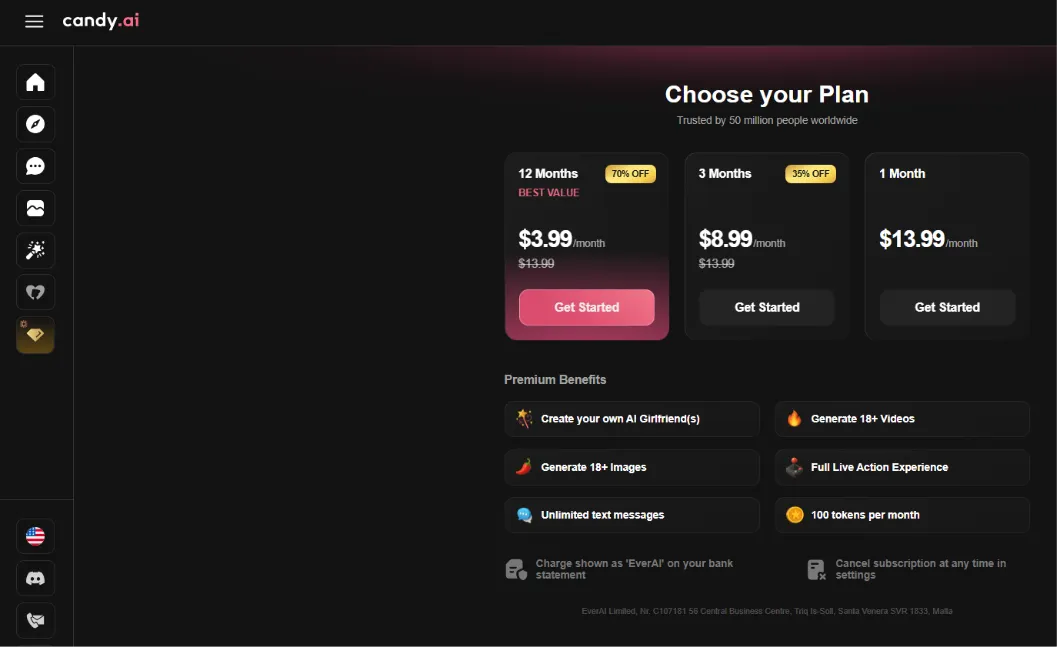
The subscription itself is competitively priced, with monthly, quarterly, and annual options where longer plans show a lower monthly-equivalent rate but bill the full term upfront.
The figures below reflect Candy AI's live plans as of our June 2026 review. Promotions and regional taxes shift these, so treat the official checkout page as the final word.
Plan | Reported price | What's included |
|---|---|---|
Free | $0 | ~100 messages, pre-made characters, limited images |
Premium monthly | ~$13.99/mo | Unlimited text, custom characters, NSFW, 100 tokens/mo |
Premium quarterly | ~$8.99/mo | Same features, billed roughly quarterly |
Premium annual | ~$3.99–5.99/mo | Same features, billed upfront for the year |
Note - Pricing as of our June 2026 review. First-time users are often offered a steep first-cycle discount. Verify current pricing at checkout.
One genuine plus sits inside the billing itself. Multiple sources confirm charges appear on bank statements under the "Everai" descriptor rather than anything that identifies the service, which provides discretion.
Crypto payment options are also available for users who want an additional layer of separation from their banking identity.
What each action costs in tokens
Here's the detail most reviews skip, and the part that makes the cost real. We have broken down the token cost of each action, which is what lets you predict your own spend instead of being surprised by it.
Action | Token cost |
|---|---|
Generate an image | 4 tokens |
One minute of voice call | 3 tokens |
Create a custom character | 10 tokens |
Convert an image to video | 12 tokens |
Unlock certain private content | 100–400 tokens |
Token packs start around $9.99 for 100 tokens and scale to roughly $299.99 for 3,750.
Those numbers translate into a per-image cost worth internalizing. At the entry pack rate, that works out to roughly $0.40 per image, dropping to about $0.08 per image at the bulk rate.
The included 100 tokens that come with premium each month cover only around 25 images, which is roughly one week of daily use, not a month.
Voice math works the same way.
At 3 tokens per minute, a ten-minute call runs 30 tokens, which is around $0.30 at bulk pricing or $3.00 at the starter pack rate.
None of these are large numbers in isolation.
The problem is how fast they accumulate once media becomes your main activity.
What a realistic month actually costs
So what does this mean for your bill? We modeled three usage patterns, and they map cleanly onto how people actually use the platform.
User type | Usage pattern | Estimated monthly total |
|---|---|---|
Light | Text-only, a few images a week within the included tokens | ~$13.99 |
Moderate | Daily chats, several images a day, occasional voice calls | ~$34 |
Heavy | Multiple daily images, video clips, private content unlocks | ~$50–80+ |
Note - SpicyRanked usage modeling across light, moderate, and heavy patterns.
The pattern is the whole story.
The subscription is the floor, not the ceiling.
A moderate user who generates 25 images a week burns the included 100 tokens inside the first week, then adds a couple of extra token packs to cover the rest of the month, which is how a sub-$14 plan turns into roughly $34.
Heavy users clear $50 to $80 without much effort, because private content unlocks alone can run 100 to 400 tokens each.
That gap between the advertised price and the real usage cost is exactly what fuels the "money trap" framing that recurs in user reviews.
It isn't that the platform hides the token system, it's that the headline price quietly understates what most engaged users end up spending.
The Two-Week Experience and the Memory Wall
The most useful thing reviewers have documented is not the feature list, it's how the experience changes over time. Nearly every short review captures the honeymoon and misses the part that actually determines long-term value.
Tracking extended daily use surfaces an arc that is remarkably consistent.
Days one to three: the honeymoon
The opening days are uniformly strong.
Onboarding is slick, with browsing and a first conversation starting within a couple of minutes of signup, and image generation that impresses immediately, returning a spontaneous-looking result from a simple prompt.
The chat in this window feels snappy and responsive, with the companion recalling details mentioned in passing and weaving them back into conversation.
This is the experience the marketing sells, and for the first stretch it largely delivers.
The honest caveat is that the first 48 hours with any AI companion are the best because novelty does most of the work, so the early glow isn't the real test.
Days four to seven: depth testing
In the middle stretch, the experience gets a harder test. Generating images in increasingly specific scenarios, a restaurant date, a rainy walk, a post-workout gym session, and the system handling complex compound requests that referenced earlier generations, which suggested a degree of visual continuity.
Conversations in this phase ranged from light banter to deeper emotional topics, and the permissive chat reportedly handled NSFW scenarios with more creativity and responsiveness than many competitors.
Through the first week, in other words, the platform mostly holds up under pressure. The cracks come later.
Days eight to fourteen: the memory wall
This is the part prospective buyers most need to know about. The first crack tends to appear around day nine, when the companion asked a question about the reviewer's job that had already been answered in detail days earlier, then forgot a preference mentioned multiple times.
The reviewer's description of the effect is worth sitting with.
The emotional bond, which had felt surprisingly genuine, started feeling slightly scripted, "like a talented actor occasionally glancing at a prompter."
The conversations didn't become bad, they stayed engaging and visually stunning, but once the memory limitation was visible it became impossible to ignore, and for a premium-priced product that's the area flagged as most in need of improvement.
There's a timeframe buyers can plan around: memory is solid for roughly the first week, and after about seven to ten days of daily use, repetition and forgotten details start to surface.
If a deep, perfectly continuous long-term bond is what you're after, that ceiling is the honest limit of what this platform currently delivers.
Candy AI Real Reviews by Real Users
Our two weeks are only one data point. To pressure test our verdict, we read through hundreds of independent reviews across the major platforms where Candy.ai is listed.
The pattern was consistent enough that we trust it, and it lines up closely with what we found ourselves.
1. Candy AI App Reviews on Trustpilot
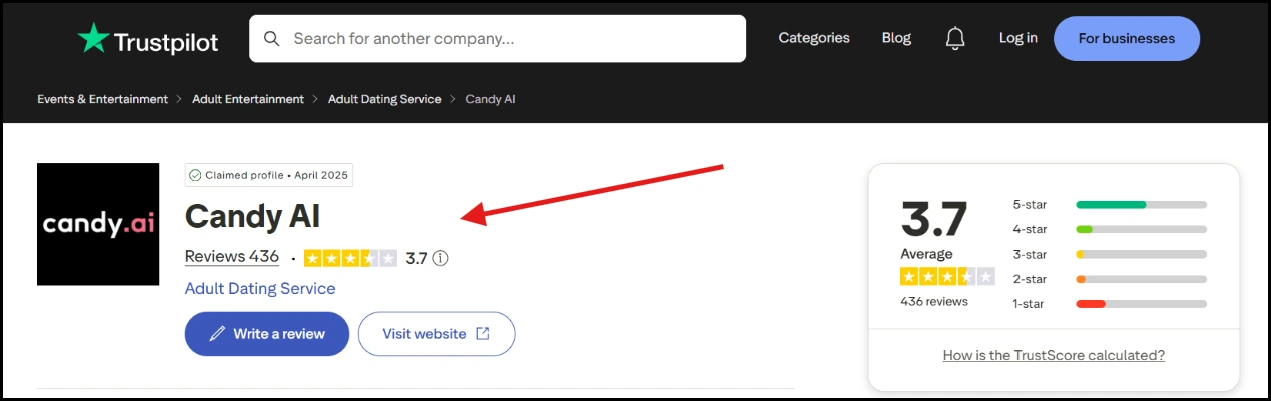
On Trustpilot , Candy.ai holds a 3.7 out of 5 rating across 415 reviews, with 400 of them posted in the last 12 months. The average alone hides the real story though, because the ratings are split into two very different camps.
Rating | Share of reviews |
|---|---|
5 star | 54 percent |
4 star | 12 percent |
3 star | 5 percent |
2 star | 7 percent |
1 star | 22 percent |
That works out to roughly two thirds of reviewers giving it 4 or 5 stars, praising the character depth, the constant updates, and how active the team is on its Discord. The company also replies to reviews publicly, which is a good sign for a platform in this space.
2. Candy AI Reviews on Reddit
Reddit sentiment mirrors Trustpilot almost exactly. Threads in communities like r/Chatbots show users praising the images, voice, and character quality, while criticizing pricing, token usage, and value.
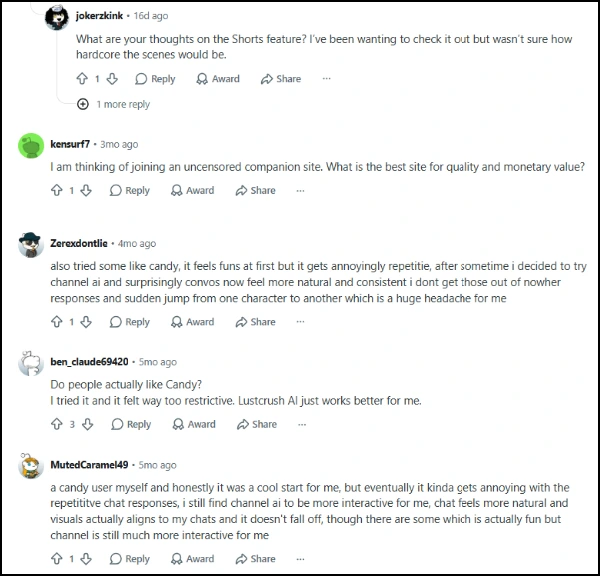
The split falls along the same line we saw everywhere. Casual chatters are happy, heavy image users feel the pinch.
Reddit is also where you find the most detailed, no filter feedback, so it is worth a scan before you subscribe.
Is Candy AI Safe and Legitimate?
On legitimacy, the independent signals are reassuring even where the user complaints aren't.
Independent security scans rate the site as very likely safe, with no malware detections across antivirus and blacklist checks, marking it as a real subscription business rather than a vanishing scam.
A clean scan only confirms the absence of malware, though, rather than vouching for billing conduct.
Data privacy is a more nuanced picture, and the sources are candid about the limits. The platform uses HTTPS and standard server security, but the company hasn't published documentation confirming end-to-end encryption for conversations, which means chats are likely stored on company servers in a retrievable form.
There's a meaningful regulatory backstop. As a company operating under EU GDPR jurisdiction, users have formal data rights including deletion requests, and account deletion is available through a "Danger Zone" section in settings. The honest caveat is that exactly what gets scrubbed versus retained after deletion hasn't been independently verified, so data permanence is a known unknown.
The reasonable summary is that Candy AI is a legitimate, scan-clean business with formal data obligations, and that you should still treat anything personal you put on it as content living on someone else's servers.
Encryption in transit lowers risk, but given the sensitive nature of this kind of content, it doesn't make a breach consequence-free, and that calculus is worth making consciously before you upload anything you'd regret leaking.
How Candy AI Compares
Candy AI doesn't exist in a vacuum, and where it wins or loses depends heavily on what you prioritize. The comparison below pulls together the consistent findings across reviewer testing on the dimensions that actually differ between platforms.
Dimension | Where Candy AI lands |
|---|---|
Image quality | Category-leading photorealism and consistency |
Customization depth | Among the deepest available |
Pricing model | Cheap base plan, separate token costs add up |
Long-term memory | Strong early, weakens after roughly a week |
Voice | Above-average, token-metered per minute |
Platform access | Browser-based web app, no native iOS app |
Note - The Above data is based on our research across documented user experience and platform data, 2026.
The reviewer consensus is consistent: if visual realism is your top priority, Candy AI sits at or near the top of the category. The trade-offs are equally consistent, namely token-driven cost creep and a memory ceiling that arrives after the first week.
Which of those matters more is exactly the question the next section helps you answer.
It's worth being clear about what the comparison does and doesn't tell you.
A platform leading on image quality is not automatically the best platform for you, because the dimensions buyers weigh differ enormously. Someone who mostly wants long, continuous text conversation will value memory and conversational depth far above photorealism, and on those axes the picture is more mixed.
Equally, the pricing model interacts with everything else. A cheap base plan looks like a clear win until you map it against a usage pattern that leans heavily on the token-metered features, at which point an all-inclusive competitor can quietly come out cheaper for the same real-world activity.
The right way to read the table above is as a starting point for matching the platform to your own priorities, not as a single overall ranking.
A Strong Alternative Worth Comparing: Kalon AI
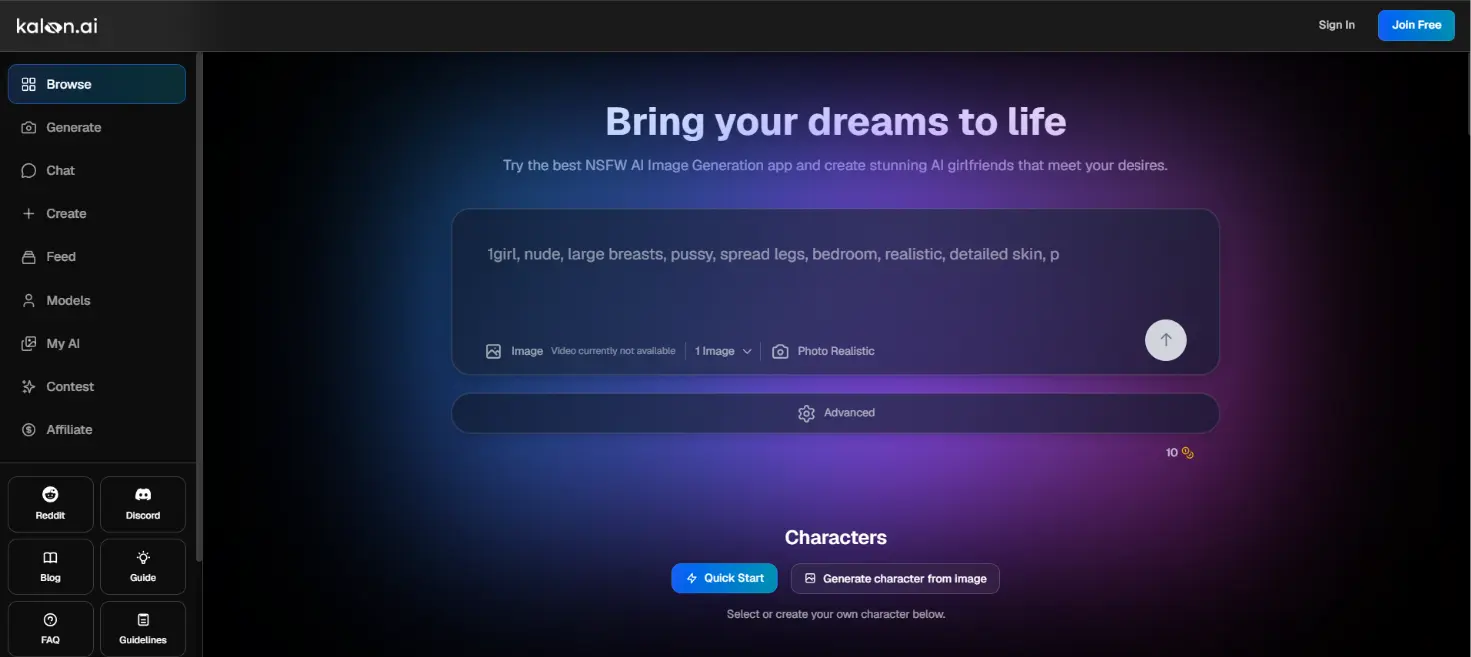
If the token math is what gives you pause, it's worth weighing Candy AI against Kalon AI before you commit.
The two platforms target a similar audience of users who want a genuinely personal AI companion, but they take different approaches to how features are bundled and priced, and that difference maps directly onto Candy AI's biggest friction point.
Kalon AI leans toward conversation depth and a cleaner relationship between what you pay and what you get, which speaks straight to the cost-predictability problem that most Candy AI complaints circle back to.
For users who were drawn to Candy AI's companionship promise but worry about an unpredictable monthly bill, it's a natural second option to evaluate side by side rather than committing to the first platform you try.
Neither platform is automatically the right answer, and that's the honest framing.
Candy AI's visual polish and Kalon AI's pricing clarity solve for different priorities, so the better fit comes down to whether category-leading image generation or a predictable, transparent cost matters more to you.
How to Avoid Overpaying on Candy AI
Most of the billing frustration is avoidable with a little planning, so if you decide to try the platform, a few habits keep the cost predictable and out of complaint territory.
Start on the shortest billing cycle rather than the annual plan. The annual rate is cheaper per month, but committing upfront before you understand your own usage is exactly how people end up requesting refunds on a year they barely touched. Treat the first month as a measurement period rather than a commitment.
Watch your token burn deliberately in that first month. Note how fast the included 100 tokens disappear once you start generating images or making voice calls, because that number, not the subscription price, is your true monthly cost. If you clear the allotment in a few days, a media-heavy pattern on this platform will be expensive, and that's your signal to reconsider before renewing.
Use the per-action token costs to budget before you spend. At 4 tokens per image and 3 per voice minute, you can estimate a week of intended use in advance and decide whether the bulk token rate is worth it for your volume. Buying tokens in larger packs drops the per-image cost substantially, so heavy users who've confirmed their pattern save meaningfully by buying ahead rather than topping up in small amounts.
Verify the live price and current terms at checkout. Promotions, regional taxes, and renewal terms shift over time, and the official subscription page is the only reliable source for what you'll actually be charged today, especially given how much the reported figures vary across reviews.
Finally, read the cancellation and refund terms before you pay, not after. The recurring refund complaints are far easier to navigate when you already know the window and the process going in, and you should only upgrade to a longer plan once daily use has actually proven the value to you.
Candy.ai Pros and Cons
- ✕Token system can balloon the real monthly cost
- ✕Memory noticeably weakens after about a week
- ✕Frequent refund and cancellation complaints
- ✕Outfit and setting accuracy in images is hit or miss
- ✕Included 100 tokens cover only ~25 images
- ✕No confirmed end-to-end encryption for stored content
- ✕Browser-only, with no native iOS app
- ✕Reported corporate jurisdiction varies across sources
Who Candy AI Is Actually For
Pulling all the research together, a clear picture emerges of who gets the most out of this platform and who tends to walk away frustrated. The deciding variable, in nearly every case, is how you plan to use it.
It's a strong fit for users who care most about how their companion looks. The image consistency and customization depth genuinely lead the category, so anyone whose priority is a visually convincing, persistent character will find a lot to like.
It also suits people who want permissive roleplay and companionship and who are comfortable managing a token budget, particularly on the annual plan where the base cost is low.
It's a poor fit for users on a tight, fixed budget who plan to lean heavily on images, voice, or video, since that's the exact profile that hits the token ceiling and ends up in the refund queue.
It's also a weaker choice for anyone whose main goal is deep, long-memory conversation, given the well-documented memory wall after the first week.
The platform rewards users who understand what they're paying for before subscribing, and punishes those who don't.
Final Verdict
8.3
8.3/10
Highly Recommended
Candy AI earns a qualified recommendation, and the qualification is entirely about how you'll use it. As a text-first companion with occasional images on the annual plan, it's a genuinely strong product backed by category-leading image quality and a legitimate business, and for that user it's easy to recommend without hesitation.
For heavy image, voice, or video use, the recommendation weakens sharply. The token system is the consistent root of the documented refund and billing complaints, and the worked monthly math shows exactly how a sub-$14 plan becomes $34 or $50-plus depending on your media habits.
Going in without budgeting for token top-ups is how most disappointed users got there. If predictable monthly cost is your priority, compare it against Kalon AI before committing, since closing that exact gap is what Kalon AI is built around.
The memory wall is the other honest limit. If you want a deep, perfectly continuous bond that holds up over months, the documented drop-off after the first week means this platform isn't there yet, and you should set expectations accordingly.
What it does deliver in that window is genuinely impressive, but it's a strong in-the-moment experience rather than a long-memory one. The bottom line: Candy AI is worth it if you go in clear-eyed about the real cost and stick to a usage pattern that fits the base subscription.
Start on the shortest plan, track your token burn for a month, and only commit to annual billing once you know your actual monthly cost. That single discipline would have prevented the large majority of the complaints documented across review platforms, and it's the difference between a satisfied user and a refund request.
Frequently Asked Questions
There's a free tier, but it's limited. It includes roughly 100 messages and basic access to pre-made characters, while custom character creation, NSFW content, voice calls, and meaningful image generation require premium. The free plan is genuinely useful for evaluating chat quality before paying for anything.
Almost certainly the token system. The subscription covers text chat, but images cost 4 tokens each, voice runs 3 tokens per minute, and video and private content cost more. The included 100 monthly tokens cover only about 25 images, so media-heavy use quickly requires buying extra packs, which is the most common reason real costs exceed the advertised price.
Strong for roughly the first week, then less reliable. Reviewer testing reports that memory holds up well early but starts showing repetition and forgotten details after about seven to ten days of daily use, which is the platform's most documented weakness.
Not by name. Charges appear under the "Everai" billing descriptor rather than anything identifying the service, and crypto payment options are available for additional privacy.
Plans can be cancelled to stop renewal, but terms vary by billing cycle and refunds are a frequent complaint. Independent assessments note recurring user difficulty with refunds and cancellations, so review the official billing terms carefully before subscribing.
No. Independent security scans rate it as very likely safe and return no malware, identifying it as a real operating business rather than a fraudulent storefront. The legitimate complaints are about billing practices, token value, and memory, not fraud.
Written by
Lena Voss
Lena Voss reviews adult dating, cam, and platform sites for SpicyRanked. Her goal is simple: help you decide if a site is worth paying for before you hand over your card. She reads the billing terms and cancellation policy first, because that is where these platforms hide the costs. Her reviews cover the things that matter most, real prices, pushy upsells, whether the user numbers are honest, and how each site protects your privacy. When a platform is good, she says so. When it is not, she tells you plainly. No hype, just a clear answer you can trust.
Meet the team →Editorial standards. SpicyRanked is for adults 18+ only and may earn affiliate commissions at no extra cost to you; our editorial reviews remain independent.