
Yes. Seeking, once called SeekingArrangement, has run since 2006 under a company that bills as W8 Tech, and it is the largest sugar dating site by member count. Legit does not mean spotless, though. The outside review sites report plenty of fake and bot profiles, so verification still matters.
In-depth reviewRecommended14 min read · Last updated Aug 24, 2026
Seeking Review 2026: Pros, Cons, and Real User Insights
After testing Seeking, here's what stands out, what falls short, and who will get the most value from the platform.

Lena Voss
Independently reviewed · Fact-checked
You found a profile that looks perfect, you go to send a message, and Seeking asks for $100 to $150. That moment is where most people start asking the real questions.
Is Seeking legit, or just a polished way to take your money?
Is it safe?
And with that price tag, is it actually worth it in 2026?
This Seeking review covers everything, the pricing, the income verification, the safety, the fake-profile complaints, and what real users are saying on Trustpilot and Sitejabber.
And if you like honest, no fluff reviews before spending money, bookmark SpicyRanked, where our team deeply and honestly analyze everything and publishes straight reviews.
By the end of this one, you will know if Seeking is worth your time and your card details. Let us get into it.
Overall Summary
Overall Score 7.0 out of 10.
Seeking, once known as SeekingArrangement, is a real and long-running sugar dating site. It started in 2006, it bills under a company called W8 Tech, and it is still the biggest name in this corner of online dating. So no, it is not a fake site that takes your money and vanishes.
The catch is the gap between the glossy marketing and what members actually get. Platinum runs $150 a month, the priciest plan we have looked at, and free profiles skip ID checks, which lets fake accounts slip through.
It is great for adults who specifically want sugar dating at scale, and less ideal for anyone after normal or casual dating who does not want to pay a premium.
Rating Category | Score |
|---|---|
Member Quality | 7.0 / 10 |
Ease of Use | 8.0 / 10 |
Value for Money | 5.0 / 10 |
Safety and Privacy | 7.0 / 10 |
Features | 7.0 / 10 |
Trust and Reputation | 4.0 / 10 |
Overall | 7.0 / 10 |
How We Scored This Seeking Review
This Seeking review pulls together public ratings from Trustpilot, Sitejabber, and Scamadviser, the platform's own pricing and policy pages, traffic data from Ahrefs checked in June 2026, and recurring feedback from member forums. Where sources disagreed, we said so instead of picking the neatest number.
We want to be upfront about the basis of the score. The numbers lean on public evidence and platform data rather than a long funded test run, and we label them that way on purpose. A review that pretends to be something it is not is worse than one that is clear about where its information comes from.
What Is Seeking?
Seeking is a niche dating site built around sugar dating. That is the setup where one person offers money, gifts, or support, and the other offers their time and company, with both sides agreeing on the terms first.
It is not a mainstream app trying to be everything to everyone. It picks one lane and stays in it.
Seeking Background: Who Owns and Runs It
It launched in 2006 as SeekingArrangement, founded by MIT graduate Brandon Wade, and changed its name to Seeking in 2019. The rebrand was meant to soften the image and move the site closer to luxury dating, but the core idea never changed.
The site runs under a company that bills as W8 Tech, and it claims more than 40 million members across over 130 countries. That long history and registered ownership are the clearest signs you are dealing with a real platform, not a fly-by-night site.
How the Seeking Sugar Dating Model Works
What makes Seeking different from a normal dating app is that the money side is out in the open.
Profiles list income, net worth, and what each person expects. There is no dancing around it, which is the whole appeal for the people who use it.
On a regular app, bringing up money early would feel rude. Here it is the first thing you sort out, and that is exactly why people who want this kind of arrangement choose Seeking over a mainstream app.
Seeking Member Types: Successful vs Attractive
Members fall into two camps.
Successful members, usually older and better off, pay for Premium.
Attractive members, who meet a few profile rules, can often message for free.
That split shapes almost everything about how the site feels day to day, from who pays to who gets the most attention. It also explains the lopsided gender balance you will notice once you start browsing.
Is Seeking Luxury Dating or Sugar Dating?
Seeking markets itself as luxury dating for successful and attractive singles, and its rules ban any straight cash-for-services deals. But it grew out of the sugar dating world, and that is still what most of the activity comes down to.
This positioning gap matters more than it sounds. If you walk in expecting a normal dating app, it will feel strange, and people who join expecting polished, conventional dating often leave frustrated within a week.
People who understand exactly what the site is, and who are comfortable with the format, tend to get far more out of it. So before anything else, be honest with yourself about which group you are in.
How Does Seeking Work?
Seeking works like a marketplace as much as a dating app. You set up a profile, say what you are looking for, then search and message within the limits of your plan. Here is each step broken down so you know what to expect from signup to your first conversation.
Signing Up and Creating a Seeking Profile
Signing up starts with picking your role, then filling in a profile that asks about income, net worth, and what you are after.
On most apps those questions would feel odd. Here they are the point, and skipping them leaves your profile looking thin and getting little traction.
Pick your role first. You sign up as either a Successful or Attractive member, and that choice shapes your whole experience.
Fill in the money fields. The profile asks for income, net worth, and expectations, which are central rather than optional.
Complete everything. A half-finished profile gets little attention, so the more complete it is, the better it performs.
Searching and Filtering on Seeking
After that you browse and filter. The search runs deeper than a standard dating app, and the filtering is genuinely one of the strongest parts of the site. If you know exactly what you are looking for, you can get very specific, very fast.
Narrow by detail. You can filter by income, education, body type, and the kind of relationship you want.
Verified profiles rank higher. Profiles with a verification badge show up more often and pull in more replies.
Speed is the payoff. The depth of the filters means less time scrolling and more time on profiles that fit what you want.
Seeking Messaging: Free vs Paid Members
Messaging is where the free and paid line really shows. This is the point where most Successful members realise they need to pay to get anywhere.
Free members are limited. Attractive members can reply within limits, but cannot do everything a paid member can.
Paid members message freely. Successful members usually need Premium to message effectively at all.
Paid messages get priority. They jump to the top of the inbox, which counts for a lot when popular profiles get flooded with messages they never open.
Seeking Verification and Trust Features
Verification sits alongside all this and is the main way the site builds trust. It is not required, but it makes a real difference to how your profile is received.
Income verification. You can confirm your income through an outside service to back up your profile claims.
Background checks. A paid background check gets you a verified identity badge for an extra layer of confidence.
Badges get attention. Profiles that carry a badge get noticeably more attention, since trust is the thing in shortest supply here.
Seeking Interface and Ease of Use
The look of the site is clean and a bit formal. It skips the playful, swipe-heavy feel of casual apps for something more buttoned up that suits its wealthier crowd.
Most members say it is easy enough to find your way around, and any learning curve comes from sugar dating itself, not the software. If you have used any dating app before, the mechanics will feel familiar within minutes.
Seeking Pricing: How Much Does Seeking Cost?
Price is the number one reason people back out of Seeking, so it is worth laying out plainly, and worth checking against the live checkout before you pay. Prices also shift by country, gender, and the occasional promotion, so treat the figures here as the standard rates rather than a fixed promise.
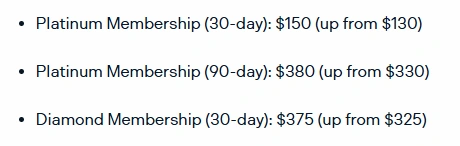
Seeking raised its prices on January 1, 2026, and renamed the Premium tier to Platinum or Gold depending on your membership level and eligibility. The 30-day Platinum plan now costs $150, up from $130, and the 90-day plan is $380, up from $330.
The top Diamond tier jumped to $375 for 30 days, up from $325. Members who subscribed or renewed before January 1, 2026 keep their old pricing while the subscription stays active, but once it lapses the new rates apply.
Plan | Price (2026) | Effective monthly | What you get |
|---|---|---|---|
Free (Attractive members) | $0 | $0 | Browse, create a profile, and message within limits if your profile is complete and public |
Platinum, 30 days | $150 | $150 | Unlimited messaging, advanced filters, priority placement, profile boost |
Platinum, 90 days | $380 | ~$126.67 | Same as Platinum, billed quarterly at a lower monthly rate |
Diamond, 30 days | $375 | $375 | Everything in Platinum plus verified badge, bigger boosts, and VIP extras |
Attractive members can use Seeking free as long as their profile is complete and shows a public photo. Hiding that photo, though, usually means paying for an add-on. So even the free side has a small paid catch if you want more control over who sees you.
To put the cost in plain terms, $150 a month is roughly four to five times what mainstream dating apps charge for their premium tiers, and the Diamond tier at $375 a month is in a league of its own.
You are paying for the niche and the scale within it, not for extra features. What you are really buying is access to a specific pool of members you will not find together anywhere else. Seeking is open that the high price is deliberate, framing it as a filter that keeps out low-effort members.
Is Seeking Diamond Membership Worth It?
Diamond is the top plan, and for most people it is hard to recommend. At $375 for 30 days it more than doubles the cost of the $150 Platinum plan, while the core stuff you actually need, messaging and search, is already covered by Platinum.
The extra visibility can help in very crowded cities where standing out is genuinely hard. But the price puts it out of reach for nearly everyone, and the gains are about exposure rather than anything you cannot do on Platinum.
Unless you are a heavy spender who wants maximum exposure in a busy market, the standard Platinum plan does the job.
Seeking Hidden Costs Worth Knowing About
A few billing quirks deserve a flag, because they sit behind most of the money complaints in the reviews. Plans renew on their own and your card stays on file, so stopping means going into account settings yourself rather than the charge simply ending. There is also no money back once you have paid for a stretch.
On top of that, members say they were charged again just to reopen old messages after a plan lapsed. Pair that with the no-refund rule, and a lapsed account can cost you twice for access you already had. It is the kind of thing you only notice after it happens, which is exactly why it shows up so often in reviews.
None of this makes Seeking a scam. Plenty of subscription sites use auto-renewal and limit refunds. But it does mean you should go in knowing the rules, set a reminder before your renewal date, and avoid letting a plan lapse if you still want your message history.
Is Seeking Legit and Does It Have Real Members?
On the legit question, the answer is yes. Seeking has run since 2006, it bills under a registered company, and it is the largest sugar dating platform by member count.
Scamadviser, which checks sites for fraud signals, rates the domain itself as safe and legitimate, noting it has been registered for years and pulls heavy traffic.
The harder question is whether the members you see are real, and the answer there is more mixed. Here is what the evidence shows.
The company and history are real. Two decades of operation under a registered company is the clearest sign Seeking is not a scam. Sites that take your money and disappear do not last this long or get this much traffic.
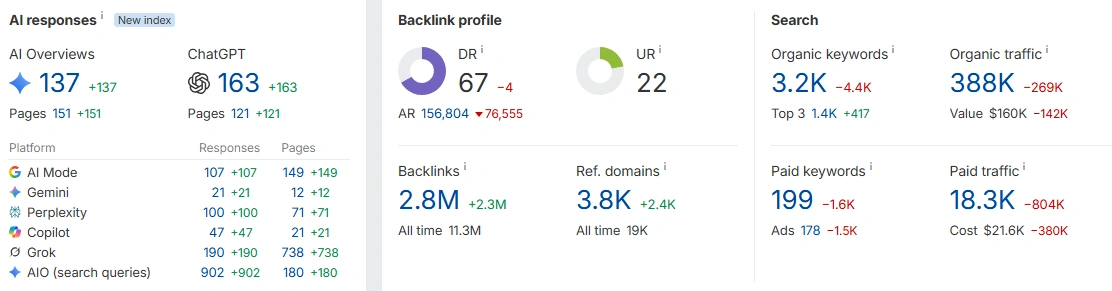
The traffic is genuine, not bought. Ahrefs data from June 2026 shows roughly 388,000 visits a month coming from regular search. Most of the interest is real demand rather than paid ads keeping an empty site alive.
Paying members get a better experience. Members who pay report more genuine connections than free users, which tells you the active, serious profiles tend to be on the paid side.
Fake and bot profiles are common on the free side. Because free profiles skip ID checks, fake accounts get through easily. The site is busy, but not every active-looking profile is a real person.
The gender balance is lopsided. The site leans heavily toward paying men chasing a smaller pool of women, so competition for genuine, active profiles can be fierce, especially for men.
Interest fades when you stop paying. Reviewers note that likes and messages dry up fast once a paid plan ends, which hints that some of the attention is tied to your subscription rather than real people reaching out.
Seeking Traffic and AI Visibility Snapshot 2026
Beyond the marketing, the real signals are how many people use a platform, how much the wider web trusts it, and whether AI assistants point people toward it.
Here is where Seeking stands as of June 2026, based on Ahrefs data.
Signal | Seeking (June 2026) | What it means for you |
|---|---|---|
Monthly organic traffic | Around 388,000 | Strong, steady search demand, which points to a real and active user base rather than an empty site. |
Paid traffic | Around 18,300 | Only a small slice of visitors come from ads, so the demand is genuine rather than bought. |
Authority score (Domain Rating) | 67 | A high trust level that reflects two decades of operation and heavy linking from other sites. |
Referring domains | Around 3,800 | Thousands of other websites reference and link to Seeking, another sign it is established. |
Organic keywords | Around 3,200 | The site ranks for a wide spread of dating searches, with 1,400 of them in the top three results. |
AI search visibility | Cited by ChatGPT, Gemini, Perplexity, Copilot and Grok | AI assistants now mention Seeking when people ask about sugar dating sites, a strong recognition signal. |
The standout here is the AI search visibility. Being referenced across ChatGPT, Gemini, Perplexity, Copilot, Grok and Google's AI Overviews shows the platform has built genuine name recognition, not just paid reach.
Is Seeking Safe? Safety and Privacy
Given the money involved, Seeking packs in more safety tools than your average dating app.
The site clearly knows that members are arranging to meet and that money is on the table, so it offers more ways to verify and protect yourself than most casual apps bother with. The stakes are real money, not just wasted time.
The Federal Trade Commission reports that victims lost $1.14 billion to romance scams in a single year, with a median loss of $2,000 per person, the highest of any imposter scam.
The tools are genuinely useful, but they work best when you actually use them and pair them with your own common sense. Here is what is on offer and where it falls short.
Income verification. You can confirm your income through an outside service, which lets paying members back up their claims. On a site built around money, being able to prove a figure is one of the most useful safety features it has.
Optional background checks. A paid identity background check is available for members who want a verified identity badge. It is not required, but it adds a real layer of confidence when both people have done it.
Private photo albums. You can share sensitive photos only with people you approve, which matters for members who want to keep their dating life separate from the rest of their life.
Discreet billing. Charges show as W8 Tech on your statement rather than Seeking, so a glance at your bank record does not give the game away.
Moderation against solicitation. The platform's terms ban cash-for-services deals and it does moderate against them, which keeps the site on the right side of its dating-platform positioning, at least on paper.
Patchy enforcement is the weak spot. In practice, members say moderation is uneven. Some report being banned by an automated system with no real explanation, while others say solicitation still slips through.
Basic precautions still matter. Meet in public the first few times, tell a friend your plans, and go slow with money and personal details. The site's tools help, but they do not replace caution.
How Good Is Seeking Verification, Really?
Verification is Seeking's headline trust feature, so it is worth a close look. Income checks run through an outside service, and identity background checks add a separate paid layer. When a profile has both, they do genuinely lift your confidence that you are dealing with a real, honest person.
The weak spot is coverage. Verification is optional and skewed toward paying members, while the free side is mostly unchecked. That is exactly where members report the most fake profiles, including accounts that show badges while using stolen photos.
So the honest read is that verification helps but does not fix the fake-profile problem. Treat a badge as a useful hint, not a promise, and trust your gut when a profile or a chat feels off.
If someone pushes to move the conversation off the platform fast, or asks for money before you have even met, those are the usual warning signs no badge can override.
Seeking Strengths and Weaknesses
Every platform has things it nails and things it could do better. Here is the honest balance sheet for Seeking, laid out side by side.
Strengths | Weaknesses |
|---|---|
Real, long-running sugar dating platform since 2006 | Expensive Premium |
Income verification that builds genuine trust | Free profiles are not ID checked, so fakes get through |
Money and expectations stated upfront | Poor Trustpilot and Sitejabber ratings around 1.4 out of 5 |
Genuine search demand, not bought traffic | Sudden account bans with no clear explanation |
Discreet billing and strong privacy controls | No refunds once you have paid |
Deep search filters and solid mobile apps | Auto-renewal and paying again to read old messages |
Seeking Strengths: What the Platform Does Well
For all the criticism it draws, Seeking has genuine advantages that explain why it still leads the sugar dating space.
These are the things it does better than the cheaper alternatives, and they are the reason serious members keep paying despite the price. Here is what stands out in its favour.
A real, long-running sugar dating platform. Seeking has operated since 2006 and bills under a registered company, with members in more than 130 countries. There is no question of it being a fake site, and that track record counts for something in a space full of short-lived apps.
Income verification that builds genuine trust. Paying members can confirm their income through an outside service and earn a verified badge. On a site where money is the whole point, being able to prove a claim is a genuine advantage over apps where anyone can say anything.
Money and expectations stated upfront. Profiles list income, net worth, and expectations openly, so both sides know the terms before a single message. That candour removes the awkward guessing game that makes these arrangements clumsy on a normal app.
Genuine search demand, not bought traffic. Traffic data shows most visitors arrive through regular search, not paid ads. A site with real returning visitors gives you a better shot at active profiles than one propped up by advertising spend.
Discreet billing that protects your privacy. Charges show as W8 Tech on your statement rather than Seeking, which matters to members who want to keep their dating life private.
Deep search filters for high-specificity matching. You can narrow by income, education, body type, and relationship type far more precisely than on a mainstream app, which saves time if you know exactly what you want.
Well-built iOS and Android apps. The native mobile apps run smoothly and score better with members than the website does on review sites.
Seeking Weaknesses: Where the Platform Falls Short
The strengths come with serious downsides, and most of the complaints in the reviews trace back to this list.
These are the problems that drag the score down and the reasons a lot of members walk away unhappy. Weigh them carefully before you pay, because several only become obvious after you have handed over your card.
Unverified free profiles and fake accounts. Because the free side skips ID verification, fake and bot accounts get through easily, and that is exactly where members report the most trouble.
Poor Trustpilot and Sitejabber ratings. Both review sites sit around 1.4 out of 5, with the same complaints repeating across hundreds of reviews.
Sudden account bans with no explanation. Members regularly report being banned by an automated system for no clear reason, sometimes right after they have paid, with little recourse.
No refunds after payment. Going by the platform's own terms, once you have paid for a membership there is no money back, even if the experience falls flat.
Auto-renewing subscriptions that keep charging. Plans renew on their own and keep your card on file, so stopping takes a manual cancellation rather than simply ending.
Paying twice to read old messages. Several members say they were charged again just to reopen past conversations after a plan lapsed.
Seeking Reviews: What Real Users Say
Seeking's own marketing paints a shiny picture, so the outside review sites are the better gauge of what members really get.
The scores below were checked in June 2026, and they are low across the board. We have laid them out by source, then explained how we read them together.
Review platform | Rating | Most common complaint |
|---|---|---|
Trustpilot | around 1.3 / 5 | Fake profiles, bans after payment |
Smart Customer | 1.4 / 5 (390+ reviews) | Overpricing, heavy paywalls |
Scamadviser (user score) | 100% | Safe |
Google Play Store | 3.9 | Still flags cost and bot accounts |
Seeking Trustpilot Reviews
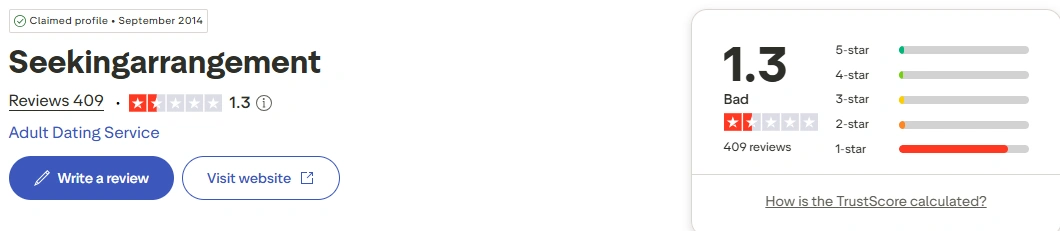
Both the Seeking and the older SeekingArrangement listings on Trustpilot sit near the bottom of the scale. The complaints repeat fake or computer-made profiles, accounts banned with no reason after a payment, and being asked to pay again to read old messages.
A few reviewers also worry about how their verification details get handled, raising concerns about uploading ID and where that data ends up. The pattern is consistent enough across reviews that it is hard to wave away as a few sour experiences.
That said, Trustpilot scores for dating sites skew negative everywhere, because happy daters rarely stop to leave a review while frustrated ones do. So read the 1.3 as a strong warning sign, but not as proof that every single member has a bad time.
Seeking Smart Customer Reviews
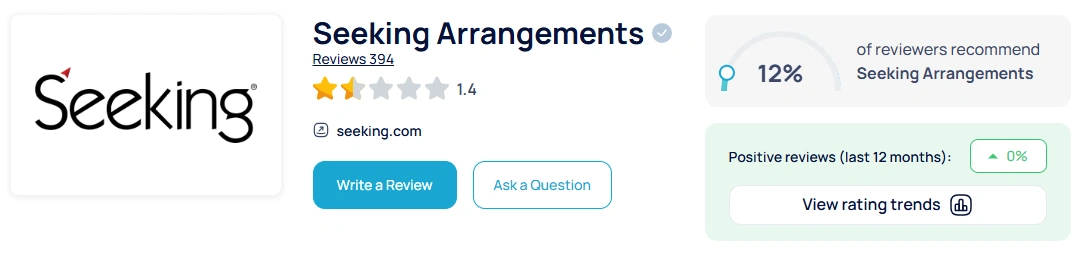
On Smart Customer, Seeking holds about 1.4 stars across nearly 400 reviews, which is a larger sample than most review sites carry. The most common gripes are fake profiles, poor support, and the high price.
A theme that comes up a lot is real members feeling buried behind paywalls, plus auto-renewal charges catching people off guard. Several reviewers describe paying, getting little in return, and then struggling to stop the next charge.
The larger review count makes this one harder to dismiss than a listing with only a handful of reviews.
Scamadviser Trust Score
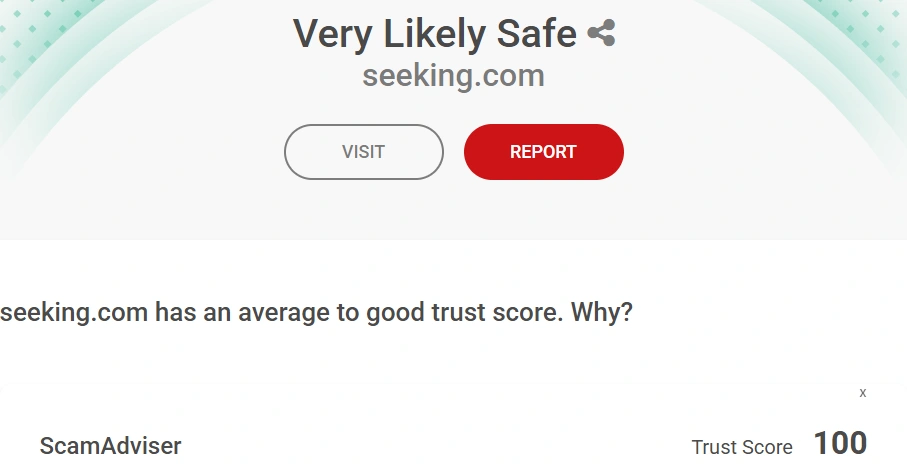
Scamadviser is less about opinion and more about trust and safety. Its automated check rates the domain as safe and legitimate, noting it has been registered for years and gets heavy traffic. For anyone worried the site itself is a fraud, that is reassuring.
App Store and Google Play Reviews
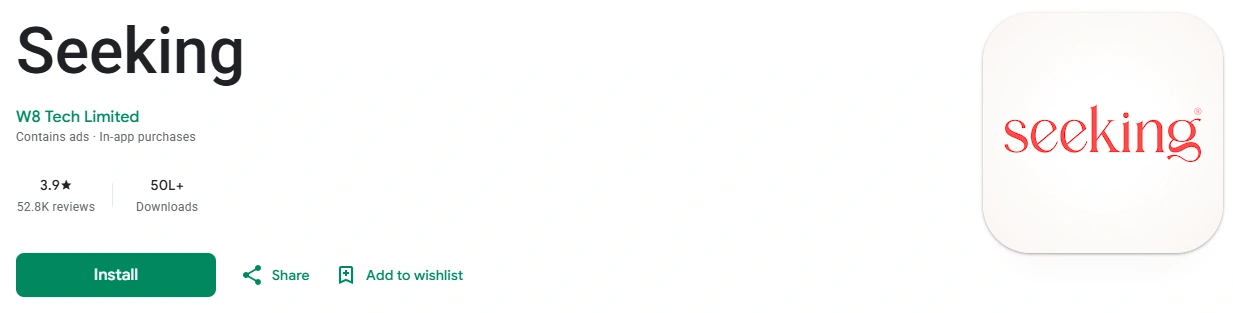
The mobile apps score better than the website does on review sites, with five-star ratings outnumbering one-star ones in several roundups. Reviewers tend to like the clean layout and the search, and the apps feel smoother than the browser version.
The catch is that the same cost and fake-profile worries still show up, just mixed in with more positive feedback about how the apps run. So the app experience is the better one, but it does not erase the underlying complaints about value and trust.
What Reddit and Forums Say
Forum discussions often give a more honest picture than star ratings alone. Many users mention issues such as fake profiles, account bans after paying, and receiving too many low quality messages.
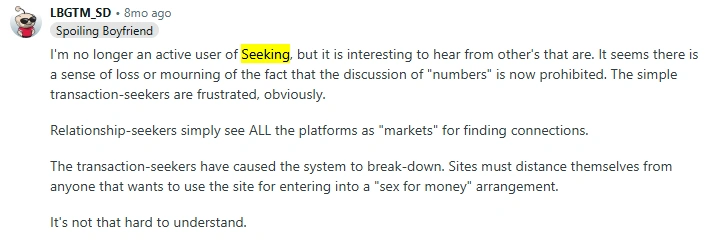
Some Reddit users believe the platform has changed because it now limits conversations about financial arrangements. One commenter explained that people looking for real relationships still find value in Seeking, while others are frustrated by the stricter rules and the ban on discussing payment expectations.
There are also positive stories from users who have built successful connections and appreciate the verification system. Like all forum discussions, these experiences are personal opinions, but the repeated patterns are worth noting.
How We Read These Seeking Reviews
Two things stand out when you put all the sources together. First, a lot of the bad reviews come from Successful members who paid, which suggests the paid experience does not always earn its price. When the people spending the most are the loudest critics, that is a signal worth taking seriously.
Second, the gap between the strong app ratings and the weak web ratings tells you the product itself works fine. The frustration is about value, moderation, and billing, not whether the buttons work. Put plainly, the software is not the problem. The cost, the fake profiles, and the billing rules are.
Common Complaints About Seeking
Across the review sites, a handful of complaints come up again and again. Here is the breakdown by theme, pulled from public reviews rather than hand-picked highlights. We have grouped them so you can see which problems are dealbreakers and which are just things to watch.
Seeking Fake Profiles and Bots
This is the single most common complaint. Members report accounts that use stolen photos yet still carry a verification badge, along with bot messages that lead nowhere.
Stolen-photo profiles. Several reviewers describe profiles using images lifted from elsewhere, sometimes even on accounts that show a verification badge.
Bot-style messages. A share of the early interest, especially on the free side, looks automated rather than coming from real people.
The free side is worst. Because free profiles skip ID checks, this is where fakes cluster, so a busy free inbox is not always a good sign.
Sudden Seeking Account Bans
The second big theme is being banned with no clear reason, which stings most when it happens right after a payment.
No explanation given. Members report bans handed out by an automated system with little or no detail about what went wrong.
Bans after paying. Several say the ban landed soon after they subscribed, leaving them feeling cheated out of the fee.
Weak appeals. Reviewers describe slow or unhelpful responses when they tried to challenge a ban.
Seeking Cost and Billing Problems
Money complaints round out the list, and they tie directly to the billing rules covered earlier.
The high price. High prices draws steady criticism, especially from members who feel they got little in return.
Auto-renewal surprises. Charges that renew on their own catch people off guard when they thought they had stopped.
Paying twice for old messages. Members report being charged again just to reopen past conversations after a plan lapsed.
No refunds. Once paid, there is no money back, even when the experience falls flat.
Privacy and Verification Worries on Seeking
A smaller but steady concern is the verification step itself and what happens to the data behind it.
Uneasy about uploading ID. Some members are reluctant to hand over identity documents or camera access to a dating site.
Questions about data handling. A few ask how that information is stored and shared with outside verification partners.
To be fair, the positives show up in reviews too. Members who find a real match talk about clear communication and genuine connections, and the income verification earns steady praise for adding a layer of trust that normal apps do not have.
The experience really is split, not all bad, which is why the honest score lands in the middle rather than at either extreme.
Who Seeking Is For, and Who Should Skip It
Seeking is built for a narrow crowd, and the single most useful thing you can do before paying is work out whether you are actually in it. This is not a site that suits a bit of everyone.
It is excellent for one specific kind of dater and a poor fit for everyone else, so be honest with yourself about which side of the line you fall on. The two lists below should make that call easy.
Who Seeking Works Best For
People specifically looking for sugar dating who want the largest member pool in that niche.
Those who like money and expectations stated upfront rather than hinted at.
Members willing to pay a premium for scale and verification tools.
Users in big cities, where the active member pool is deepest.
Who Should Avoid Seeking
Budget daters, since $150 a month for platinum is hard to justify against cheaper mainstream apps.
Anyone after normal or casual dating with no money element.
People who dislike auto-renewing charges or strict ID verification.
Anyone who wants a generous refund policy and a frictionless signup.
The short version is that if sugar dating is exactly what you want and the price does not scare you off, the site gives you more to work with than any rival. If any of the points in the second list describe you, a different platform will probably serve you better.
Seeking vs Bumble vs Tinder: How Does It Compare?
Seeking sits in a different lane from the big mainstream apps, but plenty of people weigh it against Bumble and Tinder before deciding where to spend their money. The short version is that they are built for different goals.
Seeking is for openly negotiated sugar dating arrangements at a premium price, while Bumble and Tinder are mainstream apps aimed at conventional dating, hookups, and relationships at a fraction of the cost.
Here is how the three stack up so you can see which fits what you are actually looking for.
Feature | Seeking | Bumble | Tinder |
|---|---|---|---|
Best for | Sugar dating and arrangements | Relationships, women message first | Casual dating, largest user base |
Entry paid plan | $150 / month (Platinum) | Around $40 / month (Premium) | Around $40 / month (Gold) |
Free tier | Usable for Attractive members | Yes, generous | Yes, but limited swipes |
User base | 40M+ (niche) | 50M+ monthly | 75M+ monthly |
Income verification | Yes | No | No |
Money element | Explicit and upfront | None | None |
SpicyRanked score | 7.0 / 10 | 8.0 / 10 | 7.5 / 10 |
Seeking vs Bumble
Bumble is the better pick if you want conventional dating with a focus on relationships, and its women-message-first design appeals to people tired of the usual dating app noise. It costs a fraction of Seeking at around $40 a month for Premium, with a genuinely usable free tier on top.
The trade-off is that Bumble has no money element and no income verification, so it is no use if a sugar dating arrangement is specifically what you are after. For everyday dating, though, it is cheaper, busier, and lower pressure. You can read the full breakdown in our Bumble review, which scores it 8.0 out of 10.
Seeking vs Tinder
Tinder is the volume play. With more than 75 million monthly users it has the largest pool of any dating app, which makes it the strongest option in smaller cities where niche sites like Seeking run thin. Tinder Gold lands at roughly $40 a month, again far below Seeking's $150 Platinum plan.
Like Bumble, Tinder is built for mainstream casual dating rather than arrangements, so there is no income verification and no upfront money dynamic. If you want maximum reach at a low price, Tinder wins. If you specifically want sugar dating, it does not compete. Our full Tinder review goes deeper and scores it 7.5 out of 10.
Which One Should You Choose?
It comes down to what you actually want.
Choose Seeking only if sugar dating is the specific goal and you are comfortable paying a premium for the largest member pool in that niche.
For ordinary dating, both Bumble and Tinder give you far more for your money, with Bumble leaning toward relationships and Tinder toward reach and casual connections.
For most people who are not specifically after an arrangement, a mainstream app is the smarter and cheaper choice.
How to Cancel Your Seeking Subscription
Cancelling Seeking is simple once you know where to look, and doing it early is the best way to avoid the auto-renewal charges members complain about most.
Open your account settings and find the membership or billing section
Turn off auto-renewal or select the cancel option before your renewal date
Take a screenshot of the confirmation in case you need proof later
Remember there are no refunds, so cancel ahead of the next billing date rather than after
Final Verdict
7.0
7/10
Recommended
So, is Seeking worth it in 2026? For the right person, yes, but only the right person.
Seeking is genuinely the biggest sugar dating site, it has real search demand behind it, and its verification and privacy tools are further along than most rivals in the space. Those are real strengths, and they are why the score is not lower.
But the strengths run into hard limits. The monthly price is steep, free profiles are not ID checked, and the outside review sites report steady problems with bots, bans, and billing.
The 1.3 star ratings on Trustpilot and Sitejabber are too consistent to ignore. If sugar dating is exactly what you want and you are fine paying a premium for the size of the pool, Seeking gives you the most members to work with.
For normal or casual dating, cheaper apps will treat you far better. Go in with clear eyes, check the live price yourself, and treat unverified profiles with care.
Seeking does not pretend to be for everyone, and the score reflects both what it does well in its niche and where it falls short.
Frequently Asked Questions
Seeking offers income verification, optional background checks, private photo albums, and discreet billing. The main risks members report are fake profiles, patchy moderation, and billing disputes. Normal dating safety still applies, so meet in public and guard your personal details.
Premium for Successful members is $109.99 for one month, with cheaper three and six month plans. The Diamond tier runs higher, near $274.99 a month. Attractive members can often use the site free as long as their profile is complete and shows a public photo.
For its niche, nothing else comes close on member numbers, and the high price does screen out some time-wasters. For any other kind of dating, apps costing a fraction give you much more for the money. That trade-off is why we land on 7.0 out of 10.
Sugar dating is an arrangement where one person provides money or gifts in exchange for company and other agreed terms. Seeking is built for these arrangements, with tools that let people state income, expectations, and lifestyle right up front.
Profiles use display names instead of real names, and private albums let you share photos only with people you approve. Billing shows as W8 Tech on your statement, not Seeking. Income verification is optional, though hiding your photo usually needs a paid plan.
Yes. There are native iOS and Android apps with full features, and they tend to score better on the app stores than the website does on review sites. You can download them free from the official stores.
The platform says it does not give refunds once you have paid for a membership. Plans also renew on their own and keep your card on file, so cancel through account settings before the renewal date if you do not want to be charged again.
It depends on what you want. For sugar dating, Seeking has the scale and the tools that mainstream apps do not. For ordinary or casual dating, mainstream apps are cheaper, busier, and a better fit. Seeking only makes sense if its specific niche is what you are after.
Written by
Lena Voss
Lena Voss reviews adult dating, cam, and platform sites for SpicyRanked. Her goal is simple: help you decide if a site is worth paying for before you hand over your card. She reads the billing terms and cancellation policy first, because that is where these platforms hide the costs. Her reviews cover the things that matter most, real prices, pushy upsells, whether the user numbers are honest, and how each site protects your privacy. When a platform is good, she says so. When it is not, she tells you plainly. No hype, just a clear answer you can trust.
Meet the team →Editorial standards. SpicyRanked is for adults 18+ only and may earn affiliate commissions at no extra cost to you; our editorial reviews remain independent.