
Yes. Ashley Madison is a real platform operated by Ruby Life Inc., running since 2002 and bound by a government data-security order. It is a legitimate company. Whether it delivers value is a separate question, since paying men often report fake profiles and mixed results.
In-depth reviewConditional10 min read · Last updated Aug 24, 2026
Ashley Madison Review 2026: Is It Worth It for Discreet Dating?
We checked Ashley Madison’s features, pricing, app reviews, user complaints, privacy concerns, and real dating experience to see whether it still works in 2026.

Lena Voss
Independently reviewed · Fact-checked
Imagine paying to send a message, then watching your money vanish on a profile that never replies.
That is the exact complaint thousands of men have left about Ashley Madison, the most recognized name in discreet dating.
The platform is built for married people and attached daters who want an affair without leaving a trail. Men buy credits, women join for free, and the site promises privacy at every step.
But the real question behind any honest Ashley Madison review is not whether the brand is famous.
It is whether the site is safe, real, and actually worth paying for in 2026.
This review pulls together real ratings from Trustpilot, the app stores, and consumer complaint sites, along with current pricing, traffic data, and the platform's security record.
At SpicyRanked we focus on honest reviews of adult platforms, so we report what the evidence shows, good or bad.
Ashley Madison Scorecard For 2026
We scored Ashley Madison on the six things that matter most to a new user. Each score is tied to a clear basis so you can see where the number comes from.
These scores are derived from public ratings, the security record, and platform data. We have not run a funded first-hand test account.
Category | Score | Basis |
|---|---|---|
Legitimacy | 7.5 | Real company operated by Ruby Life Inc., running since 2002 and bound by an FTC data-security order |
Security and Privacy | 8.0 | Strong post-breach rebuild with encryption, discreet billing, panic button, and PIN-locked app |
User Base and Activity | 6.0 | Large registered base and rising search demand, but frequent reports of fake and bot profiles |
Value for Money | 5.0 | Credit pricing is steep and men carry nearly all of the cost |
Mobile Apps | 6.5 | Apple rating is strong at 4.0, Google Play is weak at 2.1, so the picture is split |
Customer Satisfaction | 4.0 | Trustpilot, Sitejabber, and complaint sites skew heavily negative among paying users |
Overall | 6.5 | Genuine strengths in security and scale, held back by cost and trust complaints |
How We Reviewed Ashley Madison
We want to be upfront about our sources.
This review is built on public evidence rather than a funded test account, and we say so plainly because a review that pretends to be hands-on when it is not is worse than one that is honest about where its information comes from.
To build the assessment, we read the official site for current pricing and features, pulled live traffic and ranking data, and gathered ratings from different platforms.
We also reviewed the documented 2015 breach and the resulting government settlement. Where sources disagreed, we noted the gap instead of picking the tidiest number.
Why The Sources Matter Here
Affair-dating reviews are unusually prone to two distortions.
The first is outdated reporting that still describes the platform as it was right after the 2015 breach, before the security overhaul.
The second is competitor bias, where a blog that sells a rival site frames everything as a red flag.
We weighted the platform's current, verifiable security posture and large public rating samples above one-off claims from sources with a stake in the outcome.
We also kept in mind that angry paying users post far more often than satisfied ones, which pulls complaint-site scores down.
What Is Ashley Madison
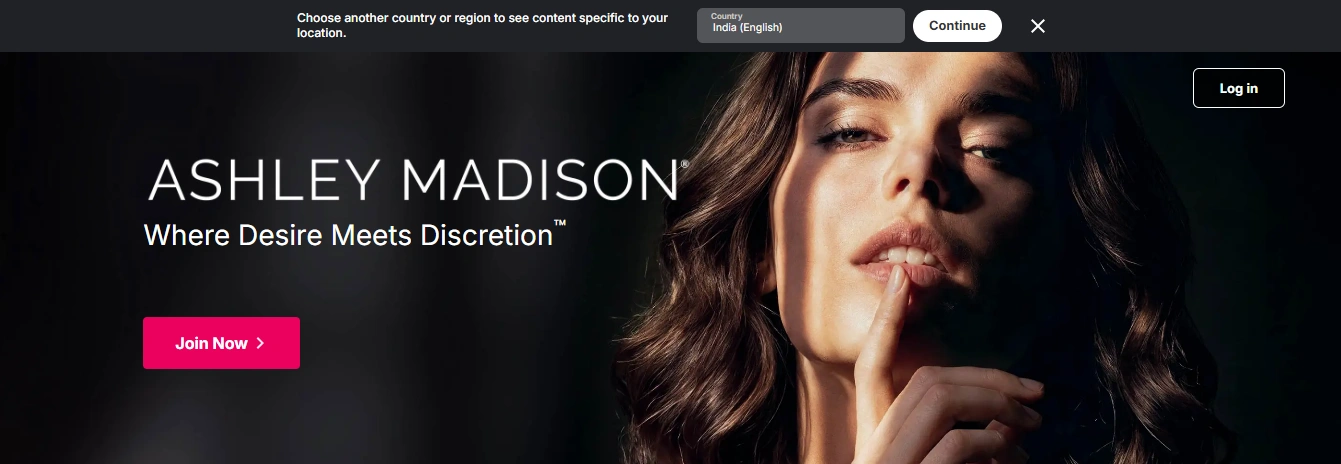
Ashley Madison is a dating platform built specifically for discreet affairs and no-strings encounters. It launched in 2002 under the slogan "Life is short. Have an affair," and it is operated by Ruby Life Inc.
The company became globally known in 2015 when hackers exposed the personal data of millions of users in one of the largest breaches in internet history.
Today the platform reports more than 80 million registered accounts across 50-plus countries. Registered numbers are easy to inflate, so they are not the same as active users.
The brand history, the affair focus, and the breach are all documented in detail on its Wikipedia entry, which is a useful neutral starting point.
Who Ashley Madison Is Best For
Based on consistent user reports, Ashley Madison works best for people who specifically want discreet encounters and value strong privacy tools.
Women get the most from it because access is free.
Men who are ready to spend on credits and who live in larger markets see better results.
It is a poor fit for budget-minded daters and anyone who cannot get past the breach history.
Key Features Of Ashley Madison
Ashley Madison is built around discretion. These are the features that shape the day-to-day experience for both sides of the platform.
Feature | What It Means For You |
|---|---|
Panic button | One click swaps the screen to a harmless site if someone walks in while you are browsing |
Blurred and hidden photos | You control who sees your real face, with masking and private galleries unlocked only for approved contacts |
Credit-based messaging | Men spend credits to open and send messages, women receive and reply for free |
Collect messages | Both people can agree to chat without the sender burning opening credits |
Traveling Man and Woman | Announce a trip and line up local connections before you arrive |
Priority Mail | A paid boost that pushes your message to the top of a busy inbox |
Discreet billing | Charges appear under a generic company name, with gift-card payment for extra privacy |
The model only works when the marketplace has real, active buyers and genuine profiles. The features are well designed, but features alone do not guarantee a good experience.
Profile quality, fake-account rates, and your local market all decide whether it pays off.
Ashley Madison Traffic And Demand
Traffic tells us whether a platform is alive and wanted, which matters because so many people still ask whether Ashley Madison shut down after the hack.
It did not.
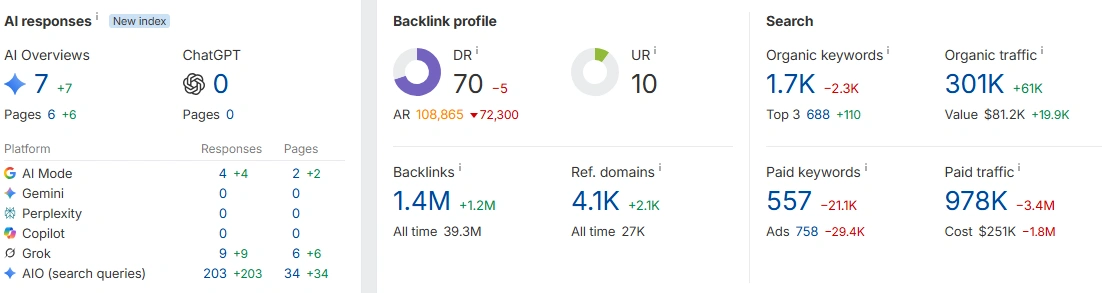
The numbers show a platform with strong, growing search demand.
According to Ahrefs data, site pulls in roughly 301,000 organic visits a month from search, up about 61,000 recently, with an estimated traffic value above 81,000 dollars and 688 keywords ranking in the top three.
For a platform some people assume is dead, that is a clear signal it is still very much in business. Strong demand does not prove quality, but it does answer the "is it still around" question directly.
How Ashley Madison Works
The flow is short and the same for everyone at signup, but the economics split sharply by gender once you start messaging.
Create an account. Sign up with an email and a username. A photo is optional and can be blurred or masked for privacy.
Set up discretion. Turn on the panic button, blur your photos, and add a PIN lock on the app if you use mobile.
Browse and wink. Search profiles by location and preference. Winks are free and signal interest without spending anything.
Spend credits to talk (men). Men buy credits and spend them to open and send messages. Women receive and reply at no cost.
Use collect messages. If both people agree, you can chat without the sender burning opening credits, which saves money.
Reports suggest the platform skews toward roughly six women for every ten men, which shapes the experience.
Women get heavy inbound attention, while men compete for replies and spend credits doing it. That imbalance is the single biggest thing to understand before paying.
Ashley Madison Cost Credits And Pricing
Ashley Madison does not use a flat monthly subscription for men. It runs on credits.
Women join and message for free.
Men buy credit packages and spend them per action, which makes the real cost depend on how much you message.
Pricing is consistent across trusted sources, though it can vary slightly by country and promotion.
Package | Price | Per credit | Who pays |
|---|---|---|---|
Basic, 100 credits | $59 | $0.59 | Men |
Classic, 500 credits | $169 | $0.34 | Men |
Elite, 1000 credits | $289 | $0.29 | Men |
Women's access | Free | n/a | Free |
A standard message costs about 5 credits. That works out to roughly 1.70 to 2.95 dollars per message depending on which package you buy.
Opening some received messages also costs credits. Gift-card payment is available, and charges show up under a generic name for discretion.
Always confirm the current price on the official checkout page before you buy.
The Real Cost Is The Credits At Low Volume
Even without a monthly fee, credits drain fast. The most common complaint from paying men is that credits vanish on profiles that never reply or that turn out to be fake.
If you message widely and get few responses, the effective cost per real conversation climbs quickly. The math only works when you message carefully and get genuine replies.
What To Check Before You Pay
Question | Why It Matters |
|---|---|
Do credits expire? | Unused credits can lose value if you go inactive |
Does anything auto-renew? | Some users report recurring charges they did not expect |
What is the refund policy? | Refunds and chargebacks are a common pain point |
Is billing discreet? | Confirm the charge descriptor before you buy |
Can you fully delete your data? | Important given the platform's breach history |
Is Ashley Madison Legit
Yes, Ashley Madison is a legitimate, operating business. It is run by Ruby Life Inc., and it is bound by a long-term data-security order from a government settlement. So it is not a fake site or a fly-by-night operation.
Legitimate as a company and worth your money are two different things. The platform is real, but user value is contested.
Many paying men report fake profiles and poor results, while women and app-store reviewers tend to rate it higher. Legit, in this case, means real and regulated, not guaranteed to work for you.
What Happened In The 2015 Data Breach
In July 2015 a group calling itself The Impact Team hacked Ashley Madison and threatened to release user data unless the site shut down.
When the company refused, the group published personal information on roughly 36 million users. The fallout was severe and made headlines worldwide.
The breach also exposed weak practices. Regulators later found the company had stored password keys in plain text and had kept data on people who paid for a "Full Delete."
A government settlement in December 2016 required the operators to build a real data-security program and pay fines, with full details in the FTC press release and the agency's plain-language breakdown of what went wrong.
We cover the breach as context, not as a how-to. We do not link to leaked data or help anyone search old dumps.
Is Ashley Madison Safe Now
Yes, On security infrastructure, the platform is in a far stronger place than it was in 2015. The settlement forced a comprehensive security program with independent assessments, and the company added encryption, discreet billing, and practical privacy tools like the panic button and PIN-locked app.
The bigger present-day risk is not the platform's servers but other users. Reviews repeatedly describe scammers who push you to move to Telegram or WhatsApp, then attempt video-call extortion. That risk is about user behavior, not the site's defenses, and it is the main thing to guard against today.
Ashley Madison Reviews Across Different Platforms
This is where Ashley Madison gets interesting, because the ratings do not agree.
App-store users, who include many women and free downloaders, rate it reasonably well.
Paying men on complaint sites rate it brutally.
We pulled the real numbers from each major source so you can see the split for yourself rather than trusting a single score.
Ashley Madison Reviews On Trustpilot
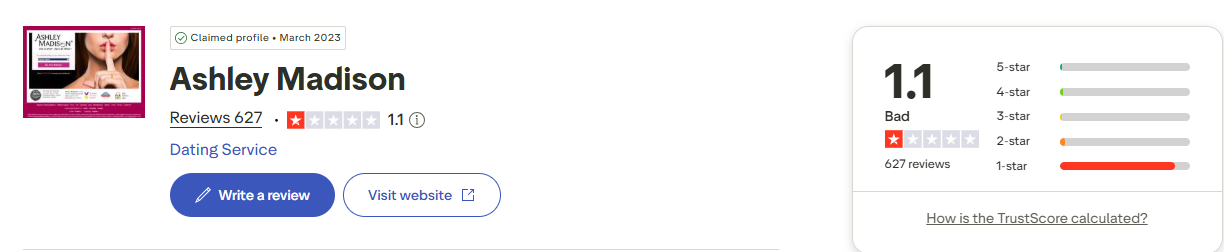
Trustpilot shows a TrustScore of about 1.1 out of 5 from roughly 620 reviews, which is overwhelmingly negative.
The recurring themes are fake profiles, credits drained by unresponsive accounts, and scam messages that push users off-platform.
The sample is small for a site this size, and Trustpilot notes the company has not responded to negative reviews, so treat it as a strong warning signal rather than the full story.
Ashley Madison Reviews On SmartCustomer
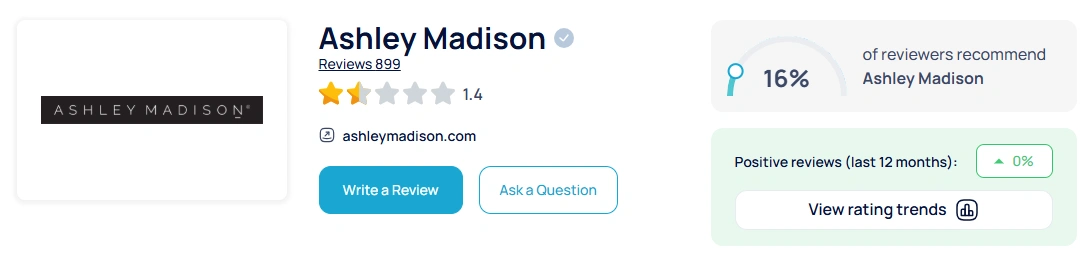
SmartCustomer gives the platform 1.4 out of 5 from 899 reviews and summarizes most customers as dissatisfied.
The dominant themes are perceived financial exploitation through credits and a high share of profiles users believe are fake.
As with the other complaint sites, the people most motivated to post are paying men who felt they got poor value, which shapes the score heavily.
Ashley Madison Reviews On PissedConsumer
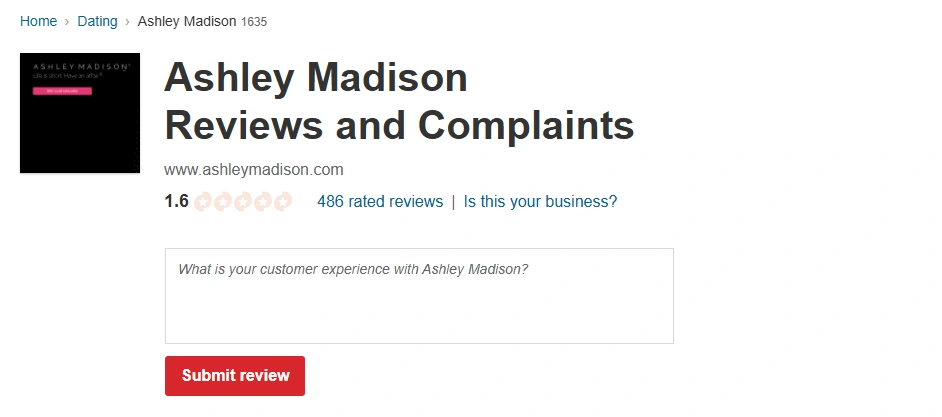
PissedConsumer holds the largest complaint sample, around 1,621 reviews at roughly 1.6 out of 5, with only a small share of users likely to recommend.
Billing dominates here.
Reviewers report unexpected charges, duplicate charges, recurring subscriptions they did not knowingly start, and difficulty getting refunds or canceling.
Support response is described as slow, especially for money and account problems.
Ashley Madison Reviews On The Apple App Store
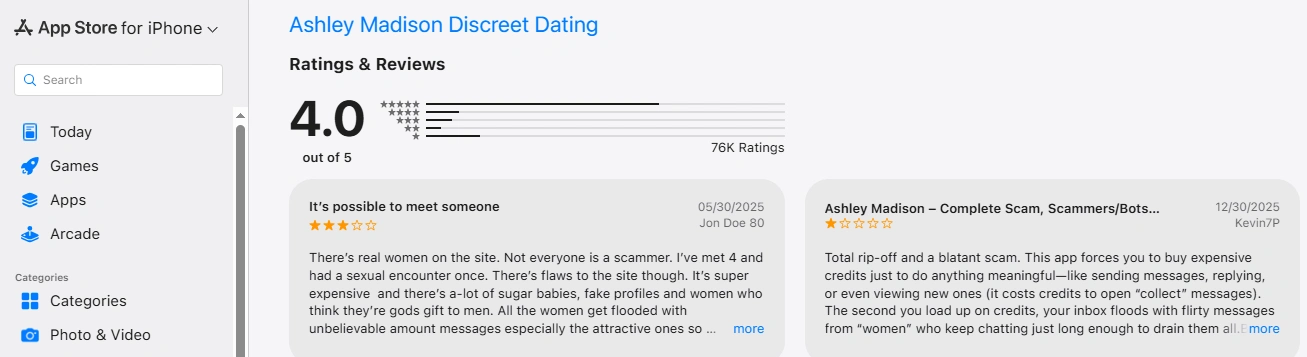
The Apple App Store tells a very different story, with about 4.0 out of 5 from roughly 76,000 ratings, and the app is often called the most popular hookup app on the store.
The far larger and more mixed-gender sample, plus the free download, likely explains the gap. App-store reviewers rate the experience of using the app, not just the cost of credits.
Ashley Madison Reviews On Google Play
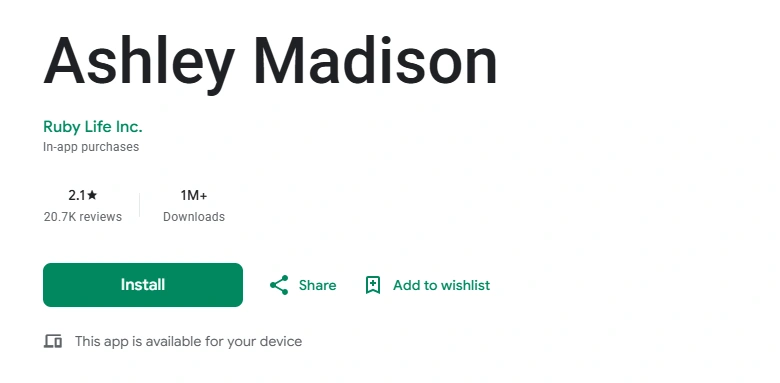
Google Play sits in the middle at about 2.1 stars from roughly 20,700 reviews, listed under developer Ruby Life Inc. with more than a million downloads.
The Android crowd is harsher than Apple's but kinder than the complaint sites.
The split between a 4.0 on iOS and a 2.1 on Android is a reminder that even the official app stores do not agree on this platform.
What Expert Review Sites Say About Ashley Madison
Editorial dating sites are far more positive than everyday users. Some sites, rates Ashley Madison around 4.0 to 4.5 out of 5, praising the discreet design and the volume of attention women receive.
The gap between expert scores and user complaint scores is itself worth noting. Experts test features, while paying users judge results and cost.
How To Read These Conflicting Ratings
The honest takeaway is not that everyone loves it or hates it. It is that your experience depends heavily on who you are.
Women and casual app users report decent experiences. Paying men, especially in smaller markets, report the worst of it.
The divergence is the real finding, so weigh the source against your own situation before you decide.
Ashley Madison Reviews on Reddit by Users
Reddit threads are anecdotal, but they surface details people leave out of star ratings. Across dating subreddits, the recurring concerns are consistent. They are worth reading as patterns, not proof.
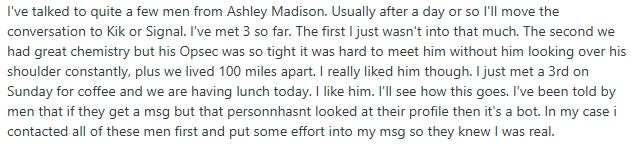
Not every Reddit experience is negative.
The example below shows one user describing multiple successful conversations and real-life meetings through Ashley Madison.
Profiles that appear to be credit drainers, sending messages mainly to make men spend
Fake or bot accounts, often with blurred photos or copied details
Matches pushing to move chats to Telegram, WhatsApp, or Cash App
Low reply rates for men despite messaging many profiles
Slow or unhelpful support on billing and account issues
None of this proves the platform is a scam, but it does mean you should treat any paid run as a test and track your own results carefully.
What You Can Realistically Expect
Set expectations by your market and your patience, not by the marketing.
In a large city, men report more matches and the occasional real meeting, though it takes credits and effort.
In smaller markets, the active pool thins out and results drop fast.
Women can expect heavy inbound attention almost immediately, which is the platform's most consistent outcome.
Plan for a few weeks of active use, careful messaging, and strict scam awareness before you judge it. Passive results are rare, and the credit model punishes spray-and-pray messaging.
If you want a sense of how it stacks up against other options, compare it with platforms we cover on our review page.
Ashley Madison Strengths And Weaknesses
Strengths
Genuine privacy tools including a panic button, photo blurring, and a PIN-locked app
Strong post-breach security required and audited under a government order
Completely free for women, which keeps inbound attention high
Discreet billing and gift-card payment for extra privacy
Large, active platform with rising search demand
The clearest brand for one specific purpose, discreet affairs
Weaknesses
Heavy complaints about fake and bot profiles from paying men
Credit costs add up fast and men carry nearly all of them
Very low scores on Trustpilot, Sitejabber, and complaint sites
Off-platform scam and extortion attempts reported by users
Billing complaints including unexpected and recurring charges
The 2015 breach still shapes trust, fairly or not
How To Use Ashley Madison Safely
If you decide to try it, protect yourself from the start. Most problems users describe are avoidable with a few simple habits.
Use a separate identity. Create a username and email that are not tied to your real name, work, or main social accounts.
Keep billing discreet. Check the charge descriptor, and consider gift-card payment if privacy is a priority.
Set up the safety tools. Turn on the panic button, blur your photos, and lock the app with a PIN.
Never move off-platform fast. Pushing to Telegram or WhatsApp early is the most common scam pattern. Stay on-site until trust is real.
Protect your credits. Be selective about who you message, and treat unresponsive or copied profiles as drainers.
Is Ashley Madison Worth It In 2026
For women, it is an easy yes to try, since access is free and attention is high.
For men, the answer is conditional.
It can be worth it if you live in a larger market, you message carefully, and you accept the credit costs as the price of a purpose-built discreet platform with no real competitor at scale.
It is not worth it if you expect cheap results, guaranteed replies, or anything passive. The complaint sites are full of men who paid, sprayed messages, and walked away frustrated.
Go in with a budget, a test mindset, and strict scam awareness, or do not go in at all.
Final Verdict
6.5
6.5/10
Conditional
Ashley Madison is a real, regulated, and well defended platform that does one thing better than anyone, discreet affairs at scale. The privacy tools are genuine and the security rebuild after 2015 is documented and audited.
That is the case in its favor. The case against it is just as real.
Paying men report fake profiles, drained credits, and off platform scams, and that shows up in punishing scores on Trustpilot, Sitejabber, and complaint sites. The app store ratings are far kinder, which tells you the experience depends heavily on who you are.
Worth a careful test for women, and for men in larger markets who can budget for credits and message selectively. Not worth it for anyone expecting cheap, fast, or passive results.
Confirm current pricing and deletion terms on the official site before you pay.
Frequently Asked Questions
The company itself is not a scam, but scam behavior by other users is common. Reviews describe fake profiles and people who push you to Telegram or WhatsApp for extortion. Stay on-platform, protect your credits, and treat unresponsive or copied profiles with caution.
Women join free. Men buy credits, with packages around 59 dollars for 100, 169 for 500, and 289 for 1000. A message costs about 5 credits, roughly 1.70 to 2.95 dollars each depending on the package. Always confirm current pricing on the official site.
Yes. Women get full access for free, including sending and receiving messages. This is why women report heavy inbound attention. Men carry nearly all of the cost through the credit system, which is the platform's core economic model.
The platform's security is far stronger now. A government settlement forced a full security program with independent audits, plus encryption and discreet billing. The bigger present-day risk is other users running off-platform scams, not the site's own defenses.
It is a real, active platform, but fake and bot profiles are a frequent complaint, especially from paying men. Use verification features, be selective about who you message, and treat blurred or copied profiles as likely drainers rather than genuine matches.
It offers strong anonymity tools. You can blur or hide photos, use a display name, lock the app with a PIN, and pay discreetly. Your real identity stays private unless you choose to share it with a specific connection.
Yes, on both iOS and Android. The app includes the panic button, PIN lock, and a customizable icon for discretion. Apple users rate it around 4.0 stars, while Google Play sits near 2.1, so the mobile experience gets mixed reviews.
Credits are spent per action, mainly to open and send messages, at about 5 credits each. Collect messages let both people chat without burning opening credits. Buy a larger package for a lower per-credit rate, and message carefully so credits are not wasted.
The credit model charges men per message instead of a flat fee, so costs rise with activity. Spending widely on profiles that do not reply makes it feel expensive fast. Costs stay reasonable only if you message selectively and get genuine responses.
Women message free. Men can use winks at no cost to signal interest, and collect messages allow a conversation without spending opening credits if both people agree. Beyond that, men generally need credits to start and continue conversations.
You can delete your profile in account settings, and a full-delete option is offered. Given the platform's history with retained data, confirm exactly what is removed and how long it takes. Keep a record of your deletion request for your own protection.
It can be, in larger markets, if you budget for credits and message selectively. Men in smaller markets and those expecting fast or passive results tend to be disappointed. Treat it as a paid test and track your own reply rate before spending more.
For discreet affairs specifically, it has no direct rival at its scale, which is its main strength. For mainstream dating, most alternatives are cheaper and simpler. Compare it against other platforms based on your goal, your market, and your budget.
Written by
Lena Voss
Lena Voss reviews adult dating, cam, and platform sites for SpicyRanked. Her goal is simple: help you decide if a site is worth paying for before you hand over your card. She reads the billing terms and cancellation policy first, because that is where these platforms hide the costs. Her reviews cover the things that matter most, real prices, pushy upsells, whether the user numbers are honest, and how each site protects your privacy. When a platform is good, she says so. When it is not, she tells you plainly. No hype, just a clear answer you can trust.
Meet the team →Editorial standards. SpicyRanked is for adults 18+ only and may earn affiliate commissions at no extra cost to you; our editorial reviews remain independent.