
Sugar Daddy Scams: 9 Red Flags and How to Check a Profile
Nine warning signs of a fake sugar daddy, a seven step profile check and exactly who to call if a scammer already has your money or photos.
Disclosure: "No sugar dating site pays SpicyRanked for this guide, and it contains no affiliate links. It is general safety information for adults aged 18 and over, not legal or financial advice."
A new match sends you a sweet message. "I want to spoil you with a weekly allowance, no need to meet. Just pay a small verification fee first so I know you are real."
That is a sugar daddy scam, and it is a common script. This guide gives you the 9 red flags of a fake sugar daddy, a quick profile check and clear steps if you already sent money or photos.
Last Updated October 19, 2026. Checked against FTC guidance, the FBI's 2025 Internet Crime Report and the safety pages of payment apps, Seeking and Private Sugar Club.
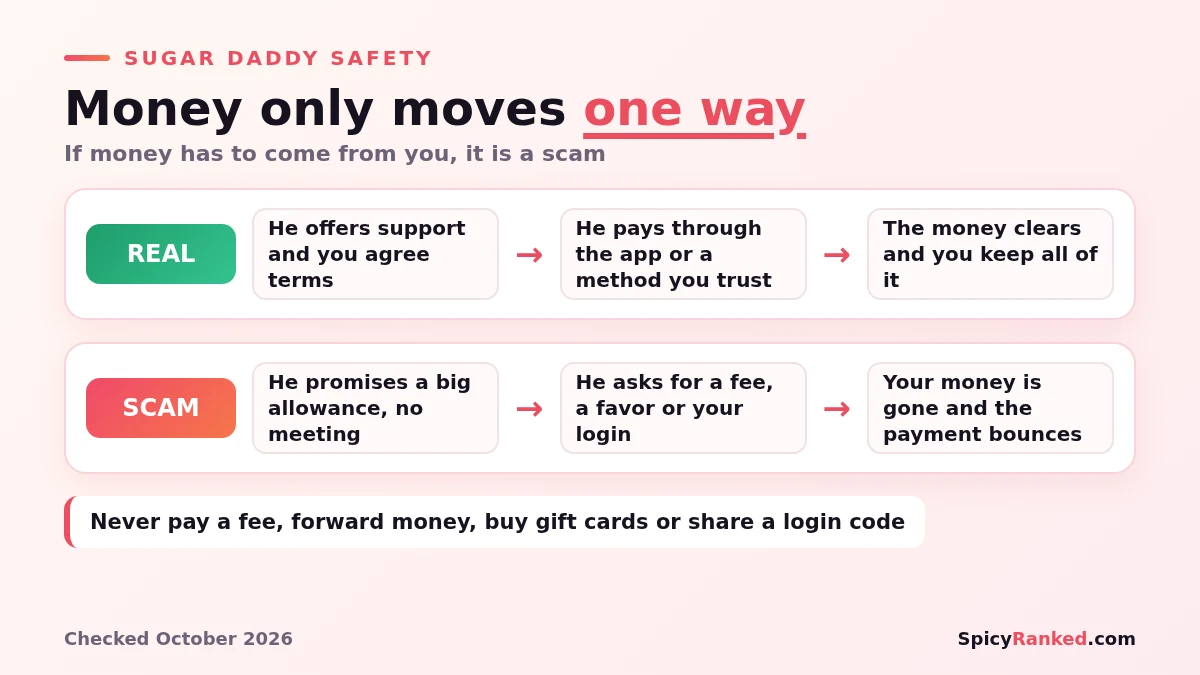
Quick answer: A real sugar daddy never needs you to send money first. A fee, a payment you must partly pass on, a request for your bank login or any talk of gift cards or crypto means it is a scam.
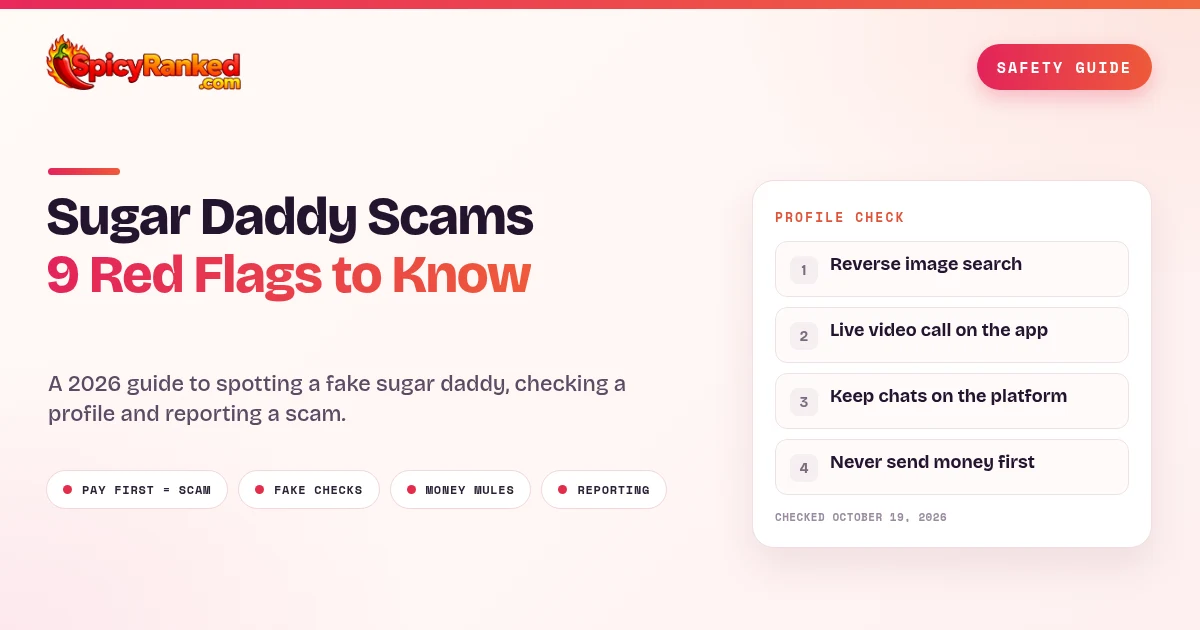
Check: run a reverse image search and consider a short live video call on the app as an extra check.
Keep: every chat and any payment on the platform where you met.
Never: pay a fee, forward money, buy gift cards or share login codes.
How Sugar Daddy Scams Work
Most sugar daddy scams follow one of three scripts, all aimed at your money, bank access or private photos.
Fee first: he promises an allowance, then asks for a "verification" or "transfer" fee. The allowance never comes.
Fake payment: he sends a fake check or pretends to transfer money, then asks you to buy gift cards or send part of the supposed payment elsewhere. If it bounces or is pulled back, you may owe the money.
Photos: he asks for intimate photos, then threatens to share them unless you pay.
The Better Business Bureau warned about the fake payment version in January 2025, based on reports to its Scam Tracker.
What the Official Numbers Say
No official source gives a separate total for sugar daddy scams. These figures cover wider categories such as romance, overpayment and sextortion fraud.
Source | What it measured | Figure |
|---|---|---|
FBI IC3, 2025 Internet Crime Report | All confidence and romance fraud in 2025 | 23,159 complaints and $929,287,469 reported lost, up from $672,009,052 in 2024 |
FBI IC3, 2025 Internet Crime Report | Overpayment scams in 2025 (keep part, send the rest on) | 2,194 complaints and $22,898,075 reported lost |
FBI IC3, 2025 Internet Crime Report | All sextortion reports in 2025, including reports involving minors | More than 75,000 submissions |
FTC Data Spotlight, April 2026 | Romance scam loss reports in 2025 in its contact method analysis that said it began on social media | Nearly 60% |
FTC, March 2026 | All fraud reported to the FTC in 2025 | 3 million reports and $15.9 billion reported lost |
These are only reported cases. The FTC notes that most scams are never reported, so real losses are likely much higher.
9 Red Flags of a Fake Sugar Daddy
No single sign proves a scam. Weigh each one alongside other inconsistencies and any money request, and if several show up, stop replying and report the profile.
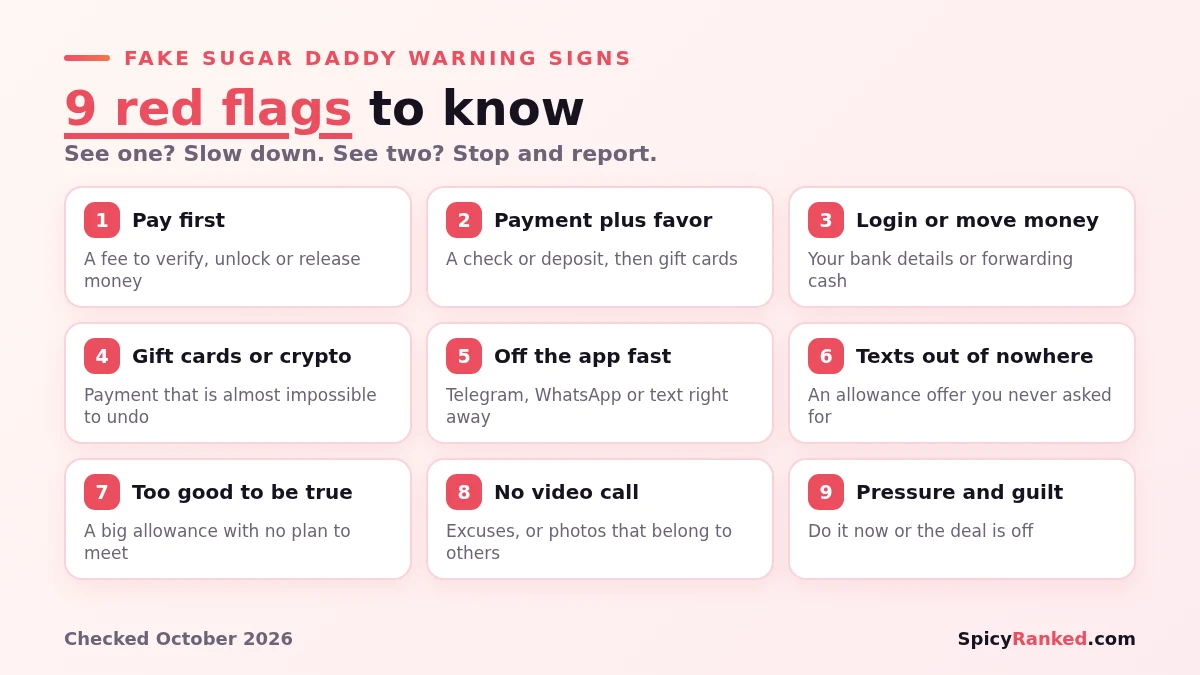
1. He Asks You to Pay Before You Get Paid
"Verification fee", "loyalty payment", "unlock fee" or "proof you are not a bot". The name changes, but you are being asked to send money so you can receive money.
That is classic advance fee fraud, which the FBI defines as paying money in the hope of getting something more valuable back and receiving much less or nothing.
Safe move: Say no and stop replying. Nobody needs your money to send you theirs.
2. He Sends a Check or Payment, Then Asks for a "Small Favor"
This one feels real because money seems to arrive first. A scammer may send a fake check or pretend to transfer money, then ask you to buy gift cards or send part of the supposed payment elsewhere.
The FTC explains that banks must make deposits available quickly, but a fake check can take weeks to be discovered. Money showing in your account does not prove a check is genuine, and you may have to repay the bank.
App payments can vanish too. Venmo warns that money paid with stolen card or bank details can be removed if the real owner reports it.
Safe move: Never spend, forward or return money from someone you have not met.
3. He Wants Your Bank Login or Asks You to Move Money
Some fakes ask for your banking login to "deposit your allowance". Others send money and ask you to forward it to someone else.
The FTC warns that forwarding money for an online love interest can involve stolen funds, which can make you what law enforcement calls a money mule. That can expose you to financial loss and possible legal trouble, even if you did not know.
Safe move: Never share a login, PIN, card number or one time code. Cash App says it will never ask for your sign in code or PIN.
4. Gift Cards or Crypto Come Up
Gift cards and crypto are scammer favorites because the money is hard to get back. The FTC says only scammers will tell you to buy a gift card and give them the numbers off the back.
Safe move: Gift cards are for gifts, not payments. Never send card numbers, photos of cards or crypto to someone you met online.
5. He Rushes You Off the App
A scammer wants you away from moderators and the report button. The FTC says romance scammers soon want to email, call or message you off the platform.
Seeking's Community Guidelines bar contacting members off the site without permission given on the platform. Private Sugar Club advises keeping all communication on its site for safety.
Safe move: Keep chatting on the app until you have checked who he is. Pushback is a warning sign to weigh with everything else, especially money talk.
6. Sugar Daddy Scam Texts Arrive Out of Nowhere
You never signed up for anything, yet a text, WhatsApp, Telegram or Instagram message offers you an allowance. That is often a mass script.
Among 2025 romance scam loss reports in the FTC's contact method analysis, nearly 60% said it began on social media.
Safe move: Do not reply, click links or send your payment app details. Block and report the account where it reached you.
7. A Huge Allowance for Nothing, and No Plan to Meet
"I will pay your bills every week, just text me." The BBB notes that fake benefactors promise a weekly allowance of hundreds and sometimes thousands of dollars.
The FTC lists "can't meet you in person" among common romance scam lies. Online only arrangements can exist, but a big promise with no meeting, no video and no history is a warning sign, especially next to a money request.
Safe move: Judge an offer by what has actually arrived and cleared, never by what is promised.
8. He Will Not Video Call, or His Photos Do Not Add Up
The BBB warns that many scammers steal photos from the internet for their dating profiles. Repeated excuses to avoid a live video call are a warning sign to weigh with other inconsistencies.
Seeking's own safety page suggests a quick phone or video call to check that a date is who they say they are.
Safe move: Run a reverse image search and consider a short live video call as an extra check. Images and video can be manipulated, and the FBI warns about generated video in live chats, so no check guarantees identity or honesty.
9. Pressure, Urgency and Guilt Trips
"Do it now or the deal is off." "I thought you trusted me."
The FTC says scammers make everything urgent because they do not want you to have time to think or to talk to someone you trust.
Safe move: Slow down on purpose. Show the chat to a friend before you do anything that involves money.
Red Flag Checklist
Screenshot this table and check any chat against it.
Red flag | Safe move |
|---|---|
1. Asks you to pay first | Say no and stop replying |
2. Payment plus a favor | Do not spend or forward it |
3. Wants your login or to move money | Never share logins or codes |
4. Gift cards or crypto | Refuse every time |
5. Rushes you off the app | Stay on the platform |
6. Texts out of nowhere | Do not reply, block and report |
7. Huge allowance, no meeting | Trust only money that has cleared |
8. No video, odd photos | Reverse image search, consider a video call |
9. Pressure and guilt | Slow down and ask a friend |
My Sugar Daddy Wants Me to Pay First. Is It a Scam?
Yes. If a sugar daddy wants you to pay first, for any reason at all, treat it as a scam.
The excuses vary, from proving you are serious to unlocking a "pending" payment. None makes sense when money is supposed to flow to you.
A short reply is enough. Try "I do not pay to receive money, so if you are genuine, send it through the app." Then stop replying and report the profile.
How to Tell if a Sugar Daddy Is Real With a 7 Step Profile Check
Run this routine before you share personal details, photos or payment information.
Reverse image search every photo. Upload the pictures to Google Images or a similar tool. If they appear under another name or on a model's page, walk away.
Look for gaps in the profile. A brand new account, a changing job story, dodged questions or few photos (a sign Zelle's romance scam guide flags) are warnings to weigh alongside any money request, not proof on their own.
Check for a verification badge, then keep checking. Seeking offers an optional background search with a related badge. Private Sugar Club's badge shows a member completed its verification process, but its Terms say it does not run criminal background checks or verify what members say, so a badge never proves honesty.
Consider a short live video call. Use the app's video chat and see if he can answer questions about his own profile. Keep private details out of your background, since the call could be recorded.
Search his name, number and email. Add the word "scam". The FTC suggests a similar trick, searching his claimed job plus "scammer", such as "oil rig scammer".
Keep everything on the platform. Chats and any payments stay where the moderators and report button are.
Never send money, codes or ID. No fees, gift cards, test transfers or ID photos. Seeking tells members to report anyone who asks for money upfront or for bank details.
Sugar Daddy Scam Texts and What They Really Mean
These example lines are our own, based on patterns the FTC and BBB describe.
The message | What is really going on |
|---|---|
"Send me your bank login so I can deposit your allowance." | Account takeover or a money mule setup |
"I sent too much by mistake, please send the rest back." | Overpayment scam, and the first payment may be fake or reversed |
"Pay a small fee so I know you are not a bot." | Advance fee scam |
"Let us move to Telegram, this app is too strict." | Getting you away from moderators |
"Send pics first so I know you are real." | Possible blackmail setup |
"Pay now or I send your photos to everyone." | Sextortion, so do not pay and report it |
Why No Meeting Offers Are a Common Scam Setup
Many people want an online only sugar daddy who pays for chat. That can exist, but it suits scammers, because they never have to show up.
One rule helps most. Money should only ever move to you, never from you, and a payment only counts once it has fully cleared.
Comparing platforms? Our guide to sugar daddy apps that send money without meeting explains how those apps really work.
Seeking's current Community Guidelines prohibit sugar dating, including any mention of "allowance" or "PPM", so an allowance offer there breaks its rules.
Our Seeking review covers how the site works.
Private Sugar Club's FAQ lists requests for gift cards, crypto, wire transfers or "verification fees" as common scam tactics, and says to report anyone who asks for money before meeting.
See our Private Sugar Club review for its verification steps and prices.
The law matters too. Laws depend on your location and what is agreed, and an arrangement that exchanges money or gifts for sexual services may breach local prostitution or solicitation laws. Seeking's rules ban escorting and paid companionship, and Private Sugar Club's Terms ban content that promotes illegal activity.
What to Do if You Were Scammed by a Fake Sugar Daddy
Act fast and skip the shame. Quick reporting gives you the best chance of stopping further losses.
Stop all contact. Send nothing else, even if he promises to "fix" it.
Save the evidence. Screenshot the profile, chats, usernames, phone numbers, payment receipts and any checks.
Call your bank or payment app right away. Tell them you paid a scammer and ask whether the payment can be reversed. Recovery is not guaranteed, and if you deposited his check, tell your bank before you spend any of it.
Secure your accounts. Change any password or code you shared and turn on two factor login. If your Social Security number was misused, go to IdentityTheft.gov, and if it was exposed without known misuse, see IdentityTheft.gov/databreach.
Report the profile on the app. Seeking lets members report from a profile, and Private Sugar Club has a report button on every profile and conversation.
Report it to the authorities. In the US, report to the FTC at ReportFraud.ftc.gov and to the FBI's Internet Crime Complaint Center at ic3.gov. Outside the US, contact your local police or national fraud reporting service.
Who you call first depends on how you paid. This table follows the FTC's advice, but recovery is never guaranteed.
How you paid | Who to contact first | What to ask for |
|---|---|---|
Bank transfer or Zelle | Your bank or credit union | Whether the payment can be reversed |
Venmo, Cash App or PayPal | The payment app | Whether the payment can be reversed |
Credit or debit card | Your card issuer or bank | Whether the charge can be refunded |
Gift card | The company that issued the card | Whether you can get a refund, and keep the card and receipt |
Crypto | The exchange or crypto ATM operator | Whether it can be reversed, though it is often hard |
Wire transfer | The wire company, such as Western Union or MoneyGram | Whether the transfer can be refunded |
A check he sent you | Your bank | Warn them it may be fake before you spend any of it |
Watch Out for Recovery Scams
After a loss, someone may promise to recover your money for a fee. The FTC reports that some victims lost even more money to people making that promise.
The FTC says it will never demand money or tell you to transfer money, so treat any upfront recovery fee as a red flag.
If He Threatens to Share Your Photos
The FTC says some romance scammers trick people into sending nude photos, then threaten to send them to their social media contacts unless they pay. The FBI's IC3 received more than 75,000 sextortion submissions in 2025, a total across all ages that includes reports involving minors.
Do not pay or send more photos. Save the messages, block the account and report it to the platform and to IC3. Being targeted is never your fault.
Sugar Daddy Scams FAQ
Bottom Line: In a Real Arrangement, Money Only Moves One Way
Every sugar daddy scam has the same weak spot. Sooner or later, the scammer needs you to send money, codes, bank access or photos.
Check every profile, keep chats on the app and never pay to get paid. If something feels off, report the profile and talk to someone you trust.
Related guides

Written by
Lena Voss
Lena Voss reviews adult dating, cam, and platform sites for SpicyRanked. Her goal is simple: help you decide if a site is worth paying for before you hand over your card. She reads the billing terms and cancellation policy first, because that is where these platforms hide the costs. Her reviews cover the things that matter most, real prices, pushy upsells, whether the user numbers are honest, and how each site protects your privacy. When a platform is good, she says so. When it is not, she tells you plainly. No hype, just a clear answer you can trust.