
How to Sell Feet Pics for Money in Australia (2026 Guide)
Selling feet pics is legal in Australia and cheap to start, but the gap between posting a photo and actually getting paid safely is where most people give up. This guide closes it.
Disclosure: This article may contain affiliate links, and we may earn a commission if you subscribe through them, at no extra cost to you.
Selling feet pics has become one of the most accessible online side incomes available to Australians.
You do not need to show your face. You do not need an existing following. The startup cost is a phone, decent light, and an afternoon of setup. That accessibility is real, and it is why thousands of Australians have tried it.
What most guides skip is the distance between posting your first photo and actually getting paid, safely and legally, on a regular basis. That distance is where people either quietly give up or get burned by a scam.
This guide is built to close it.
Over the next few thousand words we will cover exactly where Australians sell feet content in 2026 and what each platform really costs, what you can realistically expect to earn (with an honest look at why the numbers you see online are often inflated), how payments and the ATO work from an Australian perspective, and how to protect your identity and your money throughout.
The tone here is deliberately practical.
We are not going to promise you three thousand dollars a month, because that is not what happens for most people. We are going to give you the version that lets you make an informed decision and, if you go ahead, do it properly.
Is Selling Feet Pics Legal in Australia?
Yes. Selling photographs of your own feet is legal in Australia for anyone aged 18 or over. Feet content on its own is not classified as explicit adult material, and photographing and selling images of your own body is lawful.
In practice, Australian sellers operate as sole traders earning either side income or, for a smaller number, a primary income.
Four conditions keep you firmly on the right side of the line, and they are all straightforward:
You must be 18 or over. Every reputable platform verifies age with ID, and that verification protects you as much as it protects buyers.
The content must be yours. Selling someone else's images is both a legal problem and a fast route to being banned.
Keep it non-explicit unless you have chosen otherwise. Feet content sits outside adult classification, which is part of why it is such an approachable niche.
Declare your income. Once you are selling with any regularity, that money is assessable income. We cover the ATO side in detail below, because it is the part sellers most often get wrong.
One more thing worth saying up front.
This guide is about non-explicit feet content sold through legitimate, verified platforms. If a buyer starts steering you toward explicit material, off-platform payments, or meeting in person, that is your signal to stop.
We explain exactly how to handle those situations in the safety section, and knowing the script in advance makes it far easier to hold the line in the moment.
Quick Answer: Where Australians Sell Feet Pics in 2026
If you read nothing else, read this. Here are the platforms worth your attention, and who each one actually suits.
FeetFinder is the best all-round starting point for most Australians. It is the largest dedicated feet marketplace, every buyer and seller is ID-verified, and it pays weekly.
Instafeet is an established subscription-model platform, better suited to sellers who want recurring subscriber income than to someone chasing a first quick sale.
Fun With Feet is a dedicated feet marketplace with a subscription structure. Worth knowing about, but read the fee section carefully before committing.
OnlyFans works well if you are willing to build and promote a subscriber base, though it is a general platform rather than a feet specialist.
FetishFinder is the step up if your content runs broader than feet into wider fetish territory, with one of the best splits available.
Fansly offers tiered subscription pricing and genuine in-platform discovery, which OnlyFans lacks.
Footly is a newer, modern platform with tiered plans and an algorithmic discovery feed.
Snifffr takes no commission but does not process your sales, which changes the maths more than it first appears.
All Things Worn suits sellers who want to offer physical worn items alongside digital content.
FeetFinder leads that list for a specific, practical reason rather than a promotional one: it solves the hardest problem a new seller faces, which is making the first sale at all.
Everything after your first paid transaction gets easier. Getting to it is where most people stall, and a dedicated marketplace with a large verified buyer base is simply the shortest path there.
We will unpack that properly below, including the fee structure, which is a genuine consideration.
Feet Pic Platforms Compared For Australian Sellers (2026)
Here is the full field, compared on the things that actually decide your income: what it costs to sell there, what the platform takes, how you get paid in Australia, and who each one suits.
Figures are current for 2026 and drawn from platform pricing pages and seller documentation. Where a platform does not publish a figure clearly, we say so rather than inventing one.
Platform | Seller cost | Commission | Payouts | Best for |
|---|---|---|---|---|
FeetFinder | From about A$8 to A$23 a year depending on plan | 10–15% by plan | Weekly, via Paxum or crypto to AUD | Fastest route to a first sale |
Instafeet | About US$9.99 a month | 10% | Platform payout, reports of delays | Recurring subscriber income |
Fun With Feet | Subscription, recently reported near US$14.99 a month | Reported 10–20%, not clearly published | Batched, reports of delays | A secondary listing site |
OnlyFans | Free to join | 20% flat | Bank transfer or Paxum, low minimum | Building a subscriber base |
FetishFinder | Seller subscription | 10–15% by plan | Weekly, no minimum | Broader fetish content |
Fansly | Free to join | 20% flat | Bank or crypto, about a 7 day hold | Tiered pricing and discovery |
Footly | Tiered plans from about US$3.99 a month | 5–15% by tier | International payouts | Algorithmic discovery feed |
Snifffr | Membership fee | 0%, but it does not process sales | You arrange payment yourself | Confident direct sellers |
All Things Worn | Free tier or paid membership | Low to none on the paid tier | PayPal or bank transfer | Physical worn items |
How to Read that Table Without Getting Caught Out
Three traps show up constantly in this niche, and every one of them costs sellers money.
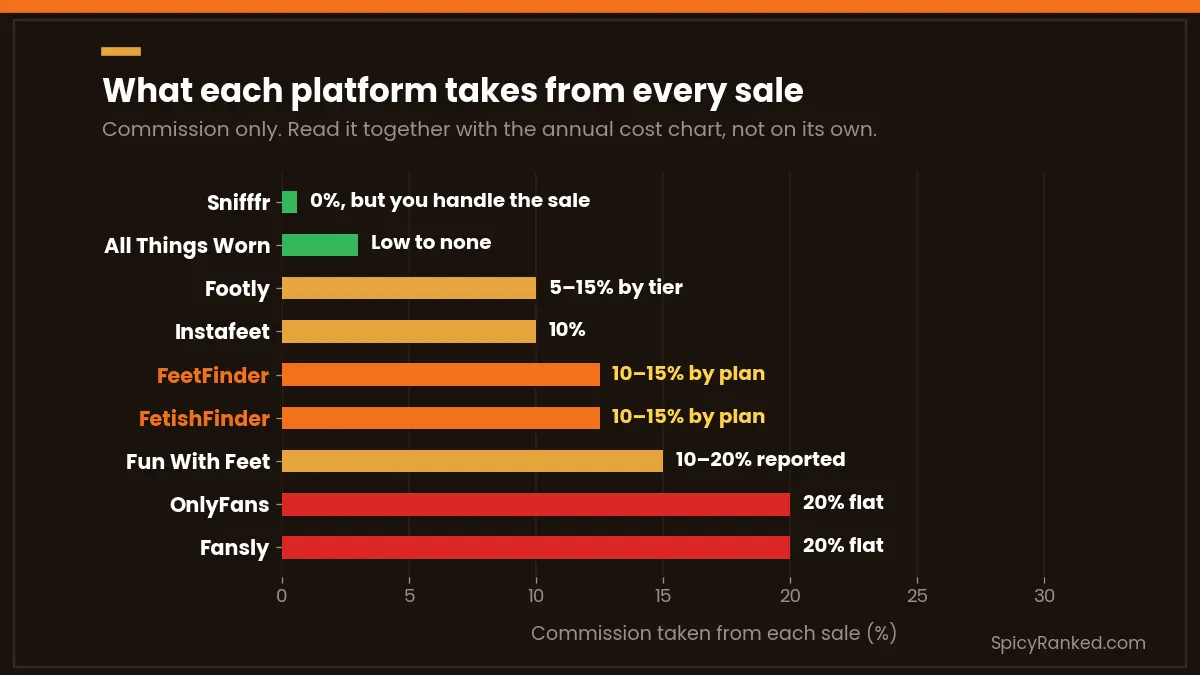
A low commission is not the same as a low cost. A platform advertising ten percent commission but charging a monthly subscription can easily cost you more across a year than one charging fifteen percent with a cheap annual fee.
Work out your total cost at your realistic sales volume, not the headline percentage.
If you expect to make around A$200 a month, a US$14.99 monthly subscription is eating roughly nine percent of your revenue before any commission is applied.
Zero commission does not mean free. Snifffr takes nothing from your sales, and that is genuinely true. But it takes nothing because it does not handle the transaction for you.
You collect payment yourself, you carry the risk of a buyer not paying, and if you are shipping physical items you cover postage and packaging.
The money the platform is not taking simply reappears as cost and risk somewhere else.
Monthly subscriptions bite hardest in slow months.
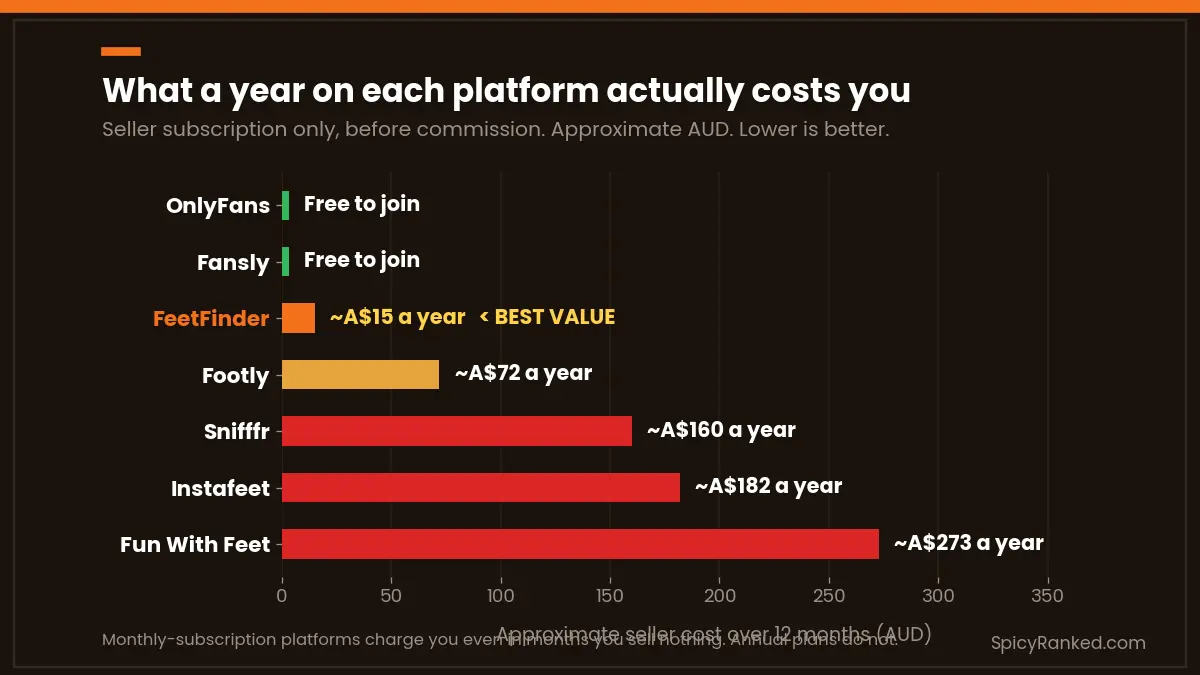
This is the fairest criticism of any subscription-model platform, and it applies to several on this list.
If you have a quiet month with no sales, an annual fee costs you almost nothing while a monthly subscription still charges you in full.
This is why annual pricing is generally friendlier to beginners with irregular income, and it is worth checking whether a platform offers one.
9 Best Places to Sell Feet Pics Australia (2026)
1. FeetFinder
FeetFinder is one of the best places to sell feet pics and operating in 2026, and for most Australians starting out it is the platform we would point you to first. The reasoning is practical rather than promotional, so let us lay it out properly, including the honest downside.
Why it works for beginners. The hardest single moment in this venture is going from zero to your first paid sale. On a general platform you are one creator among millions and buyers may simply never find you. On FeetFinder, every person browsing arrived specifically looking for feet content.
Reported figures put the platform at several million verified users with well over one hundred million dollars in total buyer spend processed since launch, which makes it the most established marketplace of its type by a wide margin.
That is the difference between hoping to be discovered and listing in a market where buyers are already shopping.
Verification is the other half of it. Both buyers and sellers are ID-verified before they can transact or message. For you that means fewer time-wasters and fake accounts in your inbox.
For buyers it means enough confidence to actually spend money rather than browse. Trust in a marketplace is what converts interest into sales, and this is the single biggest practical difference between a verified marketplace and selling through social media DMs.
The honest downside. FeetFinder charges a seller subscription. Depending on the plan this sits at roughly A$8 to A$23 for a year, plus a service fee of about ten to fifteen percent on sales.
Competitors make a lot of noise about the fact that you pay something even in a month where you sell nothing, and that criticism is fair as far as it goes.
What it usually leaves out is that the annual cost here is genuinely small, and a platform charging a monthly subscription will cost you considerably more across the same twelve months. Run the numbers for your own situation, but for most sellers the annual model is the gentler one.
How you actually use it. You build a profile, upload photos and videos, set prices for individual items, bundles, and full collections, and accept custom requests.
Customs are where many sellers earn the most, because a buyer commissioning something specific is a buyer with genuine intent and a higher budget.
Payouts run weekly, which is faster than several competitors, and international sellers including Australians are supported through payout services that you then convert to AUD.
For the full breakdown of plan differences, fee mechanics, and payout timing, see our detailed FeetFinder review.
2. Instafeet
Instafeet (officially acquired by FeetFinder) has been running since 2017, which makes it one of the older dedicated feet platforms still operating. Its model is subscription-first: buyers pay a monthly fee to access a creator's content, so your income skews toward recurring subscribers rather than one-off sales.
Creators pay a monthly subscription of around US$9.99, reduced from a higher previous tier, plus a ten percent commission on sales. That commission is genuinely competitive, but as with any monthly-fee platform, the subscription is the part to model carefully.
If you earn nothing in a given month, you still pay.
The consistent criticisms are worth knowing before you commit. Approval times have been reported as slow, sometimes running one to two weeks. The interface and discovery tools are dated compared with newer platforms, with no algorithmic feed pushing your content to new buyers.
Buyer traffic is smaller than the market leaders. None of that makes it a bad platform, and if you already have an audience there it retains value. But as a place to start from nothing in 2026, it is a slower path than a larger marketplace.
Best for: sellers who prefer a subscription income model and are willing to bring some of their own traffic.
3. Fun With Feet
Fun With Feet launched around 2021 and positions itself as a dedicated feet marketplace. It is genuinely popular and appears on most lists in this niche, so it deserves a place here, but it also requires the most careful reading of any platform on this page.
The fee picture is the issue.
Public reporting on its pricing has been inconsistent, with subscription costs described anywhere from roughly US$9.99 per three months historically to a recently reported US$14.99 per month, and commission described variously as zero, ten percent, or up to twenty percent depending on the source.
The platform does not publish a single clear, current fee schedule that resolves these differences. There are also recurring seller reports around payout delays and account issues, though we would note that several of the loudest sources making those claims are direct competitors, which is a reason to weigh them carefully rather than accept them at face value.
Our position is simply this: verify the current subscription cost and commission on the signup page yourself before you pay anything, and be clear on the payout terms.
That is sensible advice for any platform, but it matters more here than most.
Best for: a secondary listing site once you are established elsewhere, rather than your first and only platform.
4. OnlyFans
OnlyFans needs no introduction, and plenty of Australians sell feet content there successfully. It takes a flat twenty percent, leaving you eighty, with no seller subscription and a low payout minimum. Payments are reliable and the platform's scale is unmatched.
The catch is discovery, and it is a significant one.
OnlyFans does almost nothing to surface your profile to new fans, so every single subscriber has to come from your own marketing on other platforms.
If you already have a social following, that is a superb position to be in.
If you are starting from zero, you are effectively building an audience from scratch before you earn anything, which is a much longer road than listing on a marketplace where buyers are already searching.
Many Australian sellers use it as a second platform once a marketplace has given them their first income and some confidence. If you go this route, our guide to the most profitable OnlyFans niches covers how to position yourself.
Best for: sellers who already have or are willing to build a social following.
5. FetishFinder
If your content extends past feet into wider fetish territory, FetishFinder applies the same marketplace logic to a broader range of niches. It keeps one of the strongest splits available, with sellers retaining eighty-five percent on the basic plan and ninety percent on premium, and buyers browse by the specific niche they are interested in rather than scrolling a general feed.
Every seller is ID-verified, as on FeetFinder, and payouts run weekly with no minimum threshold, which is genuinely useful when you are starting out and your first few payouts are small. Categories span everything from worn items and hosiery to a wide range of fetish interests, so if you have been turning down requests because they sit outside a feet-only platform, this is where that demand lives.
The honest caveat is the same as for any niche marketplace: the total audience is smaller than a mainstream platform, and you will do best if you bring some of your own traffic.
But for creators whose range is broader than feet alone, the combination of a high split and targeted demand is hard to beat. Our FetishFinder review goes through the plan maths in detail.
Best for: creators whose content goes beyond feet into wider fetish niches.
6. Fansly
Fansly is the closest like-for-like OnlyFans alternative, running the same eighty-twenty split, but it does two things OnlyFans does not, and both matter for a seller in Australia.
First, it has genuine in-platform discovery through a recommendation feed and hashtag browsing, so new buyers can find you without you doing all the marketing.
Second, it supports multiple subscription tiers at different price points. That second feature is quietly powerful: a buyer who would never commit to a premium monthly price might happily pay a lower tier, and a proportion of those will upgrade later. Tiering widens the top of your funnel rather than forcing everyone into a single price.
Two practical notes for Australians.
The payout minimum is low for e-wallet and crypto but higher for bank transfer, and earnings sit through roughly a seven day hold before you can withdraw, so plan for ten to fourteen days from earning to money in your account.
It also supports crypto payouts, which some international sellers prefer.
Best for: sellers who want subscription income with more built-in reach than OnlyFans provides.
7. Footly
Footly is a newer entrant built around a TikTok-style algorithmic discovery feed rather than the traditional grid layout most feet marketplaces use.
Its pitch is tiered creator plans starting around US$3.99 a month, with platform fees scaling from about five to fifteen percent depending on which tier you are on, so higher-tier creators keep up to ninety-five percent of each sale.
The discovery feed is the genuinely interesting part.
Algorithmic distribution means the platform actively pushes content to buyers rather than waiting for them to search, which theoretically helps a new seller get seen without their own audience. Verification is reported as fast, typically within about a day, and it supports international payouts including to Australia.
The trade-off is maturity.
It is a much younger platform than the established marketplaces, which means a smaller total buyer pool and less of a track record on payouts and support.
Newer platforms can be excellent for early sellers who benefit from less competition, or frustrating if the buyer volume is not there yet. Worth testing as a secondary platform rather than betting your whole effort on it.
Best for: sellers who want algorithmic discovery and are comfortable trying a newer platform.
8. Snifffr
Snifffr is built around feet content and worn items, and its headline is that it takes zero commission on sales. That sounds unbeatable until you understand the mechanism behind it.
Snifffr takes nothing because it does not process your sales. It charges a membership fee and connects you with buyers, and you handle payment collection and any shipping directly. You keep one hundred percent of the money, and you also carry one hundred percent of the risk.
If a buyer does not pay, that is your problem to solve. If you are posting physical items, postage and packaging come out of your margin. The platform is not taking a cut because it is not doing the work that a cut would pay for.
For a confident seller who wants no intermediary and is comfortable managing payment safety themselves, that autonomy is genuinely appealing. For a beginner who wants the platform to handle the transaction and protect them from non-payment, a commission-based marketplace is almost always the better first move.
Our Snifffr review works through the real economics, including why a thirty dollar physical sale can net far less than a thirty dollar digital one.
Best for: experienced sellers who want full control and no middleman.
9. All Things Worn
All Things Worn is a long-running community marketplace spanning both digital content and physical worn items, which makes it a natural fit if you want to sell feet pics alongside socks, stockings, or shoes. It has genuine community features including forums and direct buyer messaging, and a buyer base built over years.
The model leans on membership tiers rather than heavy commission, so sellers keep close to the full value of a sale but pay for the membership level that unlocks the features they need.
Payments commonly run through PayPal or bank transfer, which is convenient for Australians, though the usual caution applies about using platform-recommended methods and never handing personal banking details to individual buyers.
If you are considering physical items, factor in Australian postage costs honestly. Domestic postage is manageable, but international shipping from Australia is expensive and will eat a large share of a small sale.
Price accordingly, or focus on digital content where margins are far cleaner.
Best for: sellers who want to offer physical worn items alongside digital content.
How Much Can You Realistically Earn in Australia?
This is where most guides quietly mislead people, so we are going to be direct about it.
You will find articles claiming Australian sellers routinely earn A$3,000 or more a month, sometimes with a stated beginner range starting around A$300 to A$700. Those figures are almost always published by platforms selling you a subscription, and they describe the successful minority rather than the typical experience.
Treat any earnings claim on a platform's own blog as marketing rather than data.
Here is a more honest picture, based on typical marketplace pricing and how the work actually goes:
Individual photos commonly sell for around A$5 to A$15 each, with well-presented sets and premium content sitting higher.
Custom requests are where the better money is, often A$20 to A$50 or more depending on what is being asked, because a buyer commissioning something specific has both intent and budget.
Bundles and collections let you package existing content at a higher total value, which is the most efficient way to raise your average sale.
Translating that into monthly income: a casual seller who posts occasionally and does no promotion should expect something in the range of A$50 to A$200 a month, and many earn less.
A consistent seller who posts several times a week, responds to buyers promptly, takes customs, and does some promotion can realistically build toward A$500 to A$1,000 a month over a few months of steady effort.
Sellers earning meaningfully more than that are running it as a genuine business, usually across several platforms, with real marketing behind it and often a year or more of accumulated content and repeat buyers.
The single biggest variable is not the platform.
It is consistency and promotion.
Two sellers on the same platform with the same quality of content will earn wildly different amounts based on how often they post and how much traffic they bring.
The platform is your storefront. The business is what you do with it.
For more on pricing strategy, our guide on how much feet pics sell for goes deeper into what drives higher prices.
One Genuine Advantage Australian Sellers Have
Being in Australia is not a disadvantage here, and in one respect it is a real edge. Your timezone puts you online while the largest buyer markets in the United States and United Kingdom are at their peak activity.
Australian sellers who schedule posting and message replies to overlap with US evenings often see noticeably better engagement than those posting only during Australian daytime.
It is a small scheduling adjustment with a measurable payoff, and most sellers never think to do it.
Getting Paid in Australia: Payment Methods That Actually Work
How you receive money matters for both convenience and privacy. Here is what Australian sellers use in 2026, and what to avoid.
The Options Worth Using
PayID is one of the best tools available to Australians for this kind of work. It lets you receive money using your mobile number or ABN rather than handing over your BSB and account number, which is a genuine privacy advantage.
Transfers are close to instant between Australian banks. If you register a PayID against a dedicated selling account, you have a clean, private way to receive Australian payments.
Wise is the standard choice for receiving international payments, which matters because most of your buyers will be overseas. It gives you local receiving details in several currencies and converts at genuine mid-market rates rather than the marked-up rates most banks apply.
For a seller receiving USD payouts and converting to AUD regularly, the difference across a year is real money.
Revolut works similarly for multi-currency handling and fast transfers, and some sellers prefer its interface and card options.
Paxum is worth knowing because several adult-adjacent and creator platforms, including some feet marketplaces, use it as their default payout method. You receive into Paxum, then transfer out to your Australian account.
Bank transfer using BSB and account number is universal and reliable, but shares the most detail about you. Use it with established platforms, not with individual buyers.
What to be Careful With
PayPal is convenient and widely accepted, but it carries chargeback risk, and its acceptable use policies around adult-adjacent content have caught sellers out before.
If you use it, use a separate business account rather than your personal one, and understand that a buyer can dispute a payment after receiving digital content.
Direct bank details given to individual buyers is the one genuine no. Never do this. It exposes your real name and banking information to a stranger, and there is no scenario where it is necessary.
Cash App is not available in Australia, so any buyer insisting on it is either confused or testing you.
The Rule That Covers All of it
Keep your selling finances completely separate from your personal ones.
A dedicated bank account or PayPal account for content income does three things at once: it protects your privacy, it makes tax time dramatically simpler, and it gives you a clean record of what you have actually earned.
Set this up before your first sale, not after.
Tax on Feet Pic Income in Australia: What the ATO Actually Expects
This is the section most sellers skip and the one most likely to cause real problems later. The good news is that the rules are genuinely simple once laid out.
Yes, it is taxable income
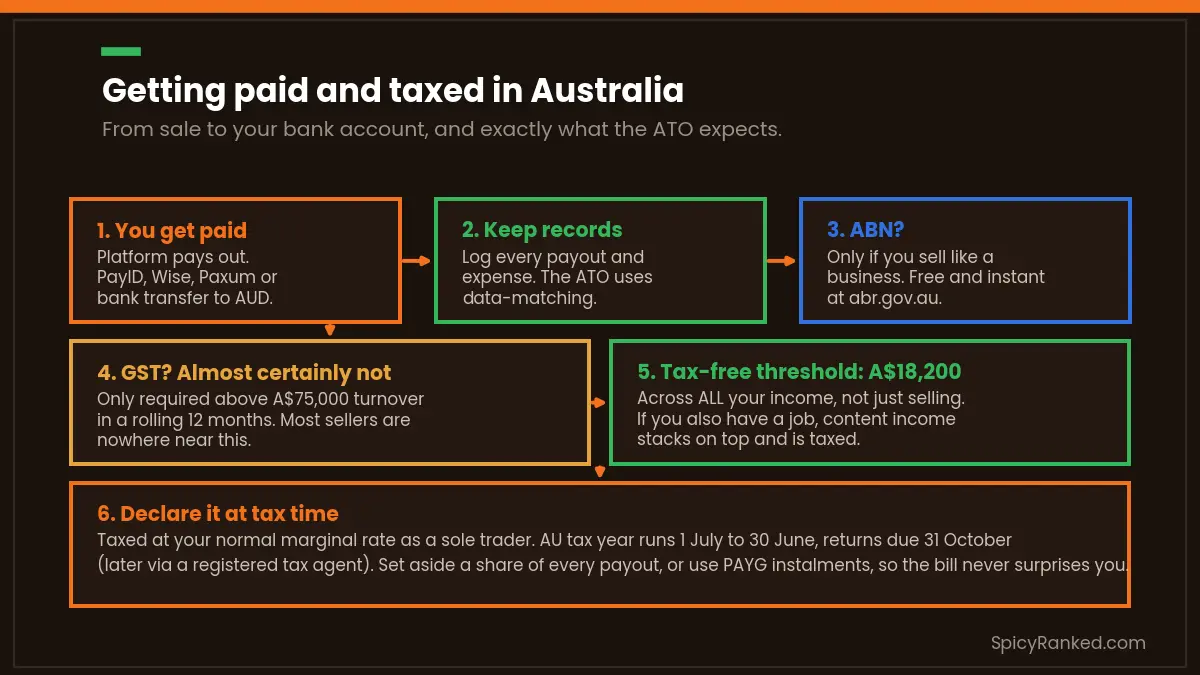
Money earned selling feet content in Australia is assessable income and must be declared. The ATO uses data-matching technology that pulls information from online platforms and payment processors, so treating this as invisible cash income is a genuine risk rather than a clever workaround.
The upside of declaring it properly is that you can also claim legitimate expenses against it.
The tax-free threshold works in your favour
Australia's tax-free threshold is A$18,200 per year. If your total income across all sources sits below that, you will not owe income tax, though you may still need to lodge a return.
For a side-income seller earning a few hundred dollars a month alongside no other income, this often means little or no tax payable.
But if you have a job as well, your content income stacks on top of your salary and is taxed at your marginal rate, so it will not be tax-free. Work out your total income, not just what you made from selling.
Sole trader, ABN, and when you need one
Most sellers operate as sole traders. Your content income goes onto your individual tax return rather than a separate business return.
Whether you need an Australian Business Number depends on whether you are operating like a business: selling regularly, promoting yourself, treating it as an ongoing income activity.
If that describes you, an ABN is free and usually issued instantly through the Australian Business Register at abr.gov.au. A genuinely occasional seller may not need one, but it costs nothing and keeps things tidy if you are serious.
GST almost certainly does not apply
You are only required to register for GST once your turnover reaches A$75,000 in a rolling twelve-month period. The overwhelming majority of feet content sellers are nowhere near that, so GST is simply not something you need to think about. If you do cross it, that is a good problem and a conversation to have with an accountant.
Expenses you may be able to claim
If you are running this as a business, you can generally claim deductions for costs directly related to producing your content.
Depending on your circumstances that might include a portion of your phone and internet, platform subscription fees, props such as hosiery or footwear bought specifically for content, lighting or photography equipment, and nail care where it is genuinely for content production.
The ATO expects records, not estimates, so keep receipts and log everything as you go. This is another reason the separate bank account matters.
Key dates and staying ahead of the bill
The Australian tax year runs from 1 July to 30 June. Individual returns are generally due by 31 October, or later if you lodge through a registered tax agent.
The practical advice is simple: set aside a portion of every payout as it arrives, so the bill is never a shock. If your income grows to a meaningful level, look into PAYG instalments, which let you pre-pay tax in smaller amounts through the year rather than facing one lump sum.
And once this becomes real money, a session with an accountant who understands online creator income pays for itself. Several Australian firms now advertise specifically for this kind of work, so you are not going to be anyone's first.
None of this constitutes tax advice. The ATO website and a registered tax agent are your authoritative sources, and your circumstances may differ.
Staying Safe: Identity, Money, and Boundaries
Safety is not a footnote in this business, it is the foundation. Done carefully, selling feet content is genuinely low risk. Done carelessly, it can expose your identity or cost you money. Here is the full picture.
Protecting your identity
Build a selling persona from day one and keep it completely separate from your real identity. That means a name that is not yours, a dedicated email address, and separate social accounts if you promote.
Never link your personal Instagram or Facebook to your selling profile, and be careful about mutual followers who might connect the two.
Before you upload any photo, check it properly. Scan the background for house numbers, street signs, mail, distinctive furniture, or anything else that places you. Watch for reflections in windows, mirrors, and glossy surfaces, which catch out more sellers than you would expect. Consider whether distinctive tattoos, birthmarks, or jewellery could identify you, and frame around them if so.
Then deal with the metadata. Most phones embed location data in every photo you take. Turn off location tagging in your camera settings, and strip metadata from images before uploading if your platform does not do it automatically. This single step prevents the most serious privacy failure possible in this line of work.
Watermark your content. A discreet watermark makes stolen images harder to resell and gives you a claim if your content is reposted. It costs you nothing and protects an asset you spent time creating.
Protecting your money
Keep transactions on the platform. This is the single most important financial rule. Platforms hold funds, mediate disputes, and give you recourse if something goes wrong. Once you move a transaction to a private arrangement, you have none of that.
Learn the standard scam patterns, because they repeat endlessly.
The overpayment scam involves a buyer sending more than agreed then asking you to refund the difference, after which the original payment reverses. The off-platform lure involves a buyer suggesting you both avoid fees by dealing directly, which conveniently also removes every protection you have.
The free sample approach involves a buyer requesting content up front with a promise to pay after, which ends exactly as you would expect. And chargeback abuse involves a buyer receiving digital content then disputing the payment with their bank.
The common thread is that every one of these requires you to step outside the platform's protection. Legitimate buyers are entirely happy to pay through the platform on the platform's terms. Anyone insisting otherwise is telling you something useful about themselves.
Learning to sell feet pics without getting scammed is mostly a matter of recognising these patterns early, and they are far easier to spot once you know the shape of them. Our full safety guide walks through each one in detail, including the exact wording scammers tend to use and how to shut the conversation down without drama.
Why you should not sell through social media DMs
Promoting on social media is fine and often necessary. Selling through direct messages is a different matter, and it goes wrong in four predictable ways: you have no payment protection and no dispute process, you are exposed to chargebacks with no recourse, you cannot verify that a buyer is who or what they claim, and most major social platforms prohibit solicitation, so you risk losing the account you built your audience on.
Use social media for what it is good at, which is getting attention. Use a proper platform for the transaction. That division keeps your income and your accounts safe.
Boundaries and wellbeing
Decide before you start what you will and will not photograph, and write it down if that helps you hold it. Buyers will occasionally push, and having decided in advance makes it far easier to say no in the moment. No amount of money is worth content you will regret.
If a buyer pressures you toward explicit material, pushes to move off-platform, asks for personal information, or suggests meeting in person, disengage, then block and report. Every reputable platform gives you those tools and expects you to use them. You are not obligated to be polite to someone making you uncomfortable, and you certainly are not obligated to keep replying.
It is also worth saying plainly that this work can be emotionally draining. Pushy or disrespectful messages come with the territory, and finding that tiring does not mean you are doing it wrong. The sellers who last are the ones who treat it as a business with firm limits, block freely, and step away when they need to.
Step by Step: How to Start Selling Feet Pics in Australia
Here is the practical sequence from nothing to your first sale, in the order that actually works.
Confirm you are eligible and get your ID ready. You must be 18 or over. Reputable platforms verify age, and that verification is a feature protecting you, not a hurdle.
Create your selling persona. Pick a name that is not yours, set up a dedicated email address, and decide now that this identity stays walled off from your personal life.
Set up separate finances. Open a dedicated bank account or PayPal for content income, and register a PayID against it if you want private Australian transfers. Do this before your first sale.
Choose your starting platform. For most Australians a dedicated verified marketplace such as FeetFinder is the fastest route to a first sale. You can add a second platform later.
Shoot your first content properly. Natural light near a window beats any equipment you can buy. Clean, uncluttered backgrounds. Steady framing. Take far more shots than you need and keep only the best.
Audit every image for safety. Backgrounds, reflections, identifying marks, and metadata. Strip location data. Add a discreet watermark.
Build a profile that converts. Write a clear, friendly bio that says what you offer. Upload a solid opening set rather than one or two images, because a thin profile reads as inactive.
Price with a ladder, not a single number. Offer individual images at an accessible price, bundles at better value, and clearly advertise that you take custom requests. The ladder lets casual buyers start small and committed buyers spend more.
Post consistently. Two to four times a week is a realistic target that keeps your profile surfacing without burning you out. Consistency beats intensity every time.
Reply promptly and professionally. Response time is one of the strongest predictors of whether a browser becomes a buyer.
Promote where it is permitted. Reddit, X, and TikTok can all drive traffic within their own rules. Send that traffic to your platform profile, never into a DM sale.
Track income and expenses from day one. A simple spreadsheet is enough. Future you, sitting down to lodge a return, will be grateful.
How to Earn More: Practical Tips That Work
Once you are set up, these are the levers that actually move your income.
Lean into custom requests. Customs consistently outperform standard listings because the buyer has already decided to spend. Make it obvious on your profile that you accept them, and respond to enquiries quickly. This is the single fastest way to lift your average sale value.
Post on the buyer's clock, not yours. As covered above, scheduling activity to overlap with US and UK evening hours puts your content in front of the largest buyer markets when they are actually online. For an Australian seller this is free leverage that most competitors ignore.
Build repeat buyers rather than chasing new ones. A buyer who has purchased once is far more likely to buy again than a stranger is to buy at all. Be responsive, deliver promptly, and treat regulars well. Repeat income is what turns a trickle into something steady.
Develop a recognisable style. Sellers who look like a coherent brand outperform sellers posting random images. Pick a consistent aesthetic, whether that is a colour palette, a setting, or a particular presentation, and stick with it so buyers remember you.
Bundle your back catalogue. Content you shot months ago still has value. Repackaging older sets into themed bundles creates new listings with no new shooting.
Consider a second platform once the first is working. Diversifying protects you if a platform changes its terms or your account has an issue, and different platforms reach different buyers. Do not spread yourself thin at the start, but once one platform is producing, adding a second is usually worth it.
Common Mistakes to Avoid
Every one of these is avoidable, and every one of them costs sellers money or safety.
Using your real name or personal social accounts. Separating your identity is the entire foundation. Do it from the first day, because retrofitting it later is close to impossible.
Uploading photos with location metadata intact. The most serious privacy failure available, and completely preventable with one settings change.
Selling through social media DMs. No protection, chargeback exposure, and a real risk of losing the account you built.
Giving buyers your bank details. There is no legitimate reason for an individual buyer to have these.
Ignoring the tax side. ATO data-matching makes undeclared platform income a genuine risk, and declaring properly lets you claim expenses.
Paying for a platform before checking current fees. Pricing in this niche changes and is often reported inconsistently. Verify on the signup page yourself.
Letting buyers push your boundaries. Decide your limits in advance and hold them. The sellers who last are the ones who do.
Expecting fast money. Most people earn modestly for the first few months. Treating it as a slow build rather than a lottery ticket is what gets you through that period.
Posting once and waiting. A dormant profile stops surfacing. Consistency is the difference between a trickle and nothing at all.
Frequently Asked Questions
The Verdict: Is Selling Feet Pics Worth It in Australia?
For the right person, with realistic expectations, yes.
The case in favour is genuinely strong. It is legal for adults in Australia, the startup cost is close to nothing, and it is one of very few income streams where you can stay completely anonymous and never show your face.
Dedicated marketplaces have made the process safer and more structured than it was even a few years ago, with ID verification on both sides of a transaction removing a large share of the risk that used to define this niche.
The tax side is straightforward, GST almost never applies, and the tax-free threshold means low earners may owe nothing at all. And Australian sellers have a small structural advantage in timezone overlap with the biggest buyer markets.
The case against is equally honest.
This is not passive income and it is not fast money. Most sellers earn a modest side income, not a wage. It requires consistent posting, prompt replies, and a willingness to promote yourself, and it comes with a steady trickle of pushy messages you will need to manage. Anyone telling you it is effortless is selling you a subscription.
If you decide to go ahead, the path is clear enough.
Start on a dedicated verified marketplace so your first sale comes as quickly as possible, because nothing sustains motivation like proof it works. Protect your identity properly from the very first upload, since that is the one thing you cannot undo later. Keep every transaction on the platform.
Set your boundaries before your first buyer tests them. Keep clean records from day one so tax time is uneventful. Then give it a few months of genuine consistency before you judge whether it is working, because almost nobody's first month looks like their sixth.
Done with care, it is a legitimate, flexible, and surprisingly low-risk way to earn money on your own terms. Done carelessly, it is a fast route to a privacy problem or a scam. The difference is entirely in the preparation, which is what this guide was written to give you.

Written by
Sasha Bell
Sasha Bell writes the rankings, comparisons, and buyer guides for SpicyRanked. Most 'best of' lists are built to rank on Google, not to help you choose. Sasha builds hers the other way, starting from the decision you are actually trying to make. Best value, safest for privacy, best for beginners, each is a different question with a different answer. Her lists use the same standards our reviewers use, so they always match the deeper reviews behind them. Her guides also show you how to spot a platform that wastes your money. The goal is simple: respect your time and your wallet.