
FeetFinder Taxes in 2026: What US Sellers Owe and How to File
Yes, FeetFinder income is taxable in the US. Report it on Schedule C, track deductible expenses, and plan for self-employment tax and quarterly payments.
Yes, FeetFinder income is taxable in the US. FeetFinder's Seller Agreement says taxes are "solely Seller's responsibility," and the IRS says gig income must be reported even without a 1099. File it on Schedule C.
If your net self-employment earnings are $400 or more, you also owe 15.3% self-employment tax through Schedule SE.
Last Updated October 1, 2026. Checked against IRS.gov and FeetFinder's own Seller Agreement, Terms of Service and FAQ on October 1, 2026. This FeetFinder taxes guide covers US federal taxes only. Selling from Britain?
Read our UK guide to feet pic tax and HMRC rules instead. Selling from Australia?
See how to sell feet pics in Australia.
Disclosure: "FeetFinder is a SpicyRanked affiliate partner. If you sign up through our links, we may earn a commission at no extra cost to you. This guide is for adults aged 18 and over. It is general information, not tax advice."
Tax rules change and every situation is different, so consult a qualified tax professional, such as a CPA or an IRS enrolled agent, before you file.
Quick answer: FeetFinder says it is not responsible for withholding income tax from your payouts, so you pay it yourself.
Report all FeetFinder income on Schedule C, subtract business expenses like the FeetFinder service fee and your seller plan, and pay 15.3% self-employment tax on Schedule SE once net self-employment earnings reach $400.
FeetFinder's FAQ says US sellers get 1099 forms from Segpay, its payment partner. A missing 1099 does not make the income tax-free.
Do You Pay Taxes on FeetFinder Earnings?
Yes. Money you earn selling feet pics, videos or worn items on FeetFinder is taxable income in the US, whether it is a full-time hustle or a few sales a month.
The IRS Gig Economy Tax Center says you must report gig income "even if the income is" from "part-time, temporary or side work," not reported on a Form 1099-K, 1099-MISC, 1099-NEC or W-2, or paid in "cash, property, goods, or virtual currency."
Selling goods online and providing creative services are both on its list of gig work.
The IRS Form 1099-K FAQs (Fact Sheet 2025-08) put it even more plainly: "All income, no matter the amount, is taxable unless the tax law says it isn't." There is no special exemption for feet content, for small amounts, or for income paid to an anonymous seller name.
Is Selling Feet Pics a Hobby or a Business?
For most active sellers, it is a business. The IRS says an activity belongs on Schedule C when "your primary purpose" is "income or profit" and you are involved "with continuity and regularity."
The IRS fact sheet on hobbies versus businesses looks at factors like whether you keep accurate books, advertise or promote the activity, and change methods to improve profits. Paying for a seller plan, setting prices and promoting your profile all point toward a business.
Hobby status rarely helps you. Hobby income still has to be reported, on Schedule 1 (Form 1040), and IRS Publication 525 says hobby expense deductions "are limited." Losses from a not-for-profit activity cannot offset your other income.
If you are unsure which applies, this is a good question for a tax professional.
What Does FeetFinder's Seller Agreement Say About Taxes?
FeetFinder puts taxes entirely on you.
The FeetFinder Seller Agreement (Effective Date shown on the page: June 9th, 2023; accessed October 1, 2026) has a section titled "Taxes" that opens with this line:
"Taxes are solely Seller's responsibility. FeetFinder recommends that Seller seek professional Tax advice to ensure that Seller is compliant with Seller's Tax obligations under applicable law based on Seller's individual circumstances."
The same section adds four points every US seller should know:
Reporting to the IRS: "FeetFinder may file reports concerning income with any taxing authority, including the US Internal Revenue Service."
Possible withholding: FeetFinder "may withhold any amounts due to Seller that FeetFinder determines in good faith must be withheld under US tax law."
Your promise: by selling, you state you "will report in the future the receipt of all payments" to the tax authority where you live.
Account risk: "FeetFinder may close Seller's account if it is notified of or becomes aware of any Tax non-compliance by Seller."
The agreement also says FeetFinder is "not responsible for withholding or paying any income, payroll, Social Security, or other foreign, federal, state, or local taxes" for you. In plain English: you are not a FeetFinder employee, and nothing is set aside for the IRS unless you do it yourself.
FeetFinder's Terms of Service (Effective Date: 30th January 2026) repeat this under "Tax Compliance" and warn that non-compliance can lead FeetFinder to "suspend your account, restrict earnings, or limit access to payouts."
The Seller Agreement's "Registration" clause adds: "If Seller lives in the US, Seller must also submit a completed W-9 Form." The W-9 gives a payer your correct taxpayer identification number (TIN) so income paid to you can be reported to the IRS.
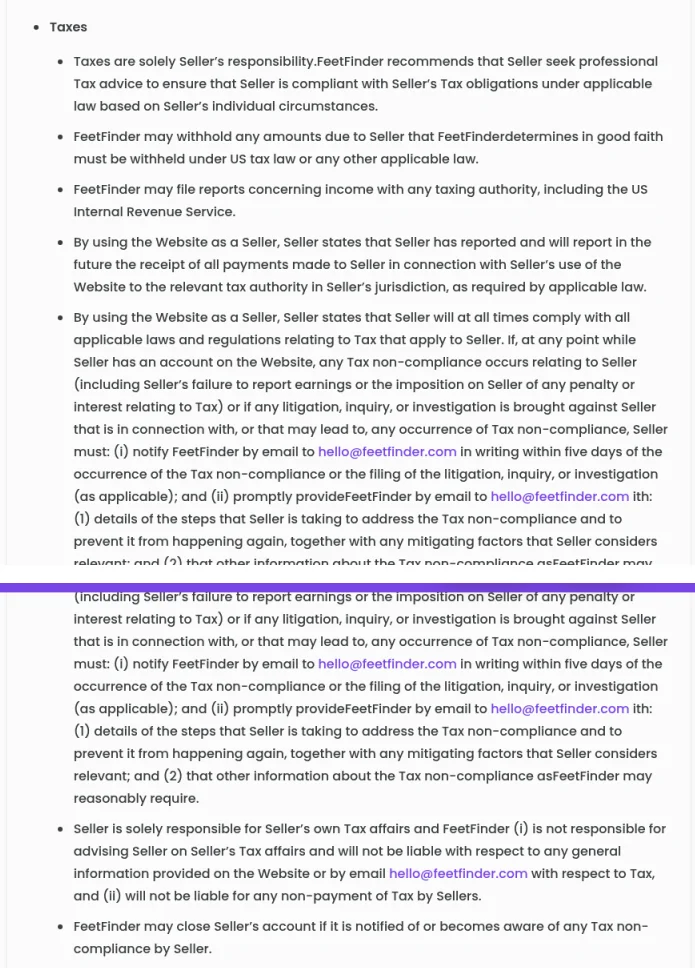
FeetFinder Seller Agreement, "Taxes" section. Screenshot captured October 1, 2026.
Does FeetFinder Send a 1099?
FeetFinder says yes, through Segpay. Its FAQ answer to "Do I Have To File Taxes/Report My Earnings?" reads:
"Yes, if you are based in the US and make over $600 per year we will send you 1099 forms. The forms will come from Segpay (our partner bank) and will be discreet. If you are based outside the US, you are responsible for filing your taxes in accordance with your countries tax laws."
Two things to keep in mind. First, the answer does not say which 1099 form you will get. Second, the $600 figure is FeetFinder's own policy, not the federal threshold, which has changed, as the table below shows.
Whether you receive a form for a given year depends on the form type, your totals and the payer.
Either way, the form only reports income. It does not decide whether you owe tax. Watch your email and mail from Segpay in January: payers generally must send 1099-K and 1099-NEC copies by January 31, while some 1099-MISC statements are due February 15.
If a form shows the wrong amount or TIN, ask the issuer for a corrected form. The IRS says it "can't correct your Form 1099-K."
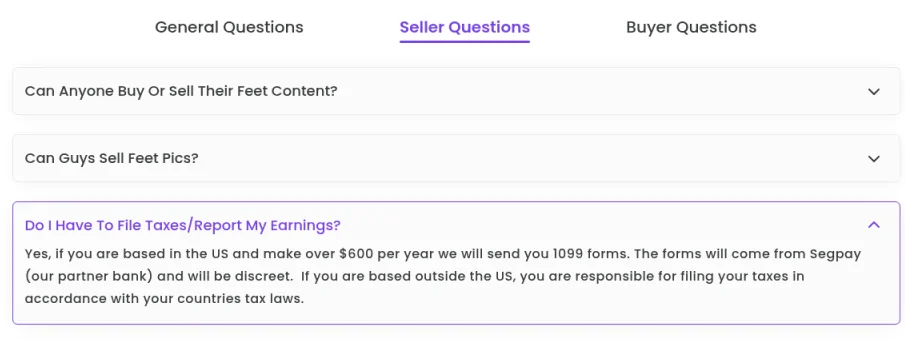
FeetFinder FAQ, "Do I Have To File Taxes/Report My Earnings?" Screenshot captured October 1, 2026.
1099-K, 1099-NEC and 1099-MISC Thresholds for 2025 and 2026
The federal 1099-K threshold for payment apps and online marketplaces is over $20,000 and more than 200 transactions. The 1099-NEC threshold and the main 1099-MISC threshold rose from $600 to $2,000 for payments made in 2026.
Form | Who sends it | Tax year 2025 | Tax year 2026 |
|---|---|---|---|
Form 1099-K (payment apps and online marketplaces) | Third party settlement organizations (TPSOs) | Over $20,000 and more than 200 transactions | Over $20,000 and more than 200 transactions |
Form 1099-K (payment cards) | Card processors, when customers pay you directly by card | No minimum | No minimum |
Form 1099-NEC | A business paying you for services as a nonemployee | $600 or more | $2,000 or more (inflation-adjusted from 2027) |
Form 1099-MISC | A business paying other income, such as prizes or rents | $600 or more for rents, prizes and other income ($10 for royalties) | $2,000 or more for rents, prizes and other income ($10 for royalties) |
Form W-9 | You give it to FeetFinder when you register | Not a threshold form | Not a threshold form |
The 1099-K rule comes from the One, Big, Beautiful Bill (OBBB), a 2025 federal tax law.
In news release IR-2025-107 (October 23, 2025), the IRS said the law "retroactively reinstated" the old threshold, so TPSOs "are not required to file Forms 1099-K unless the gross amount of reportable payment transactions to a payee exceeds $20,000 and the number of transactions exceeds 200."
The IRS Understanding Your Form 1099-K page shows the same rule today.
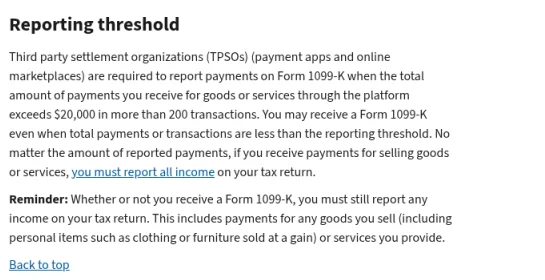
IRS.gov, "Understanding your Form 1099-K," reporting threshold section. Screenshot captured October 1, 2026.
For 1099-NEC and 1099-MISC, the IRS Instructions for Forms 1099-MISC and 1099-NEC say that "for tax years beginning after 2025," the threshold "increased to $2,000 and may be adjusted for inflation beginning in calendar year 2027."
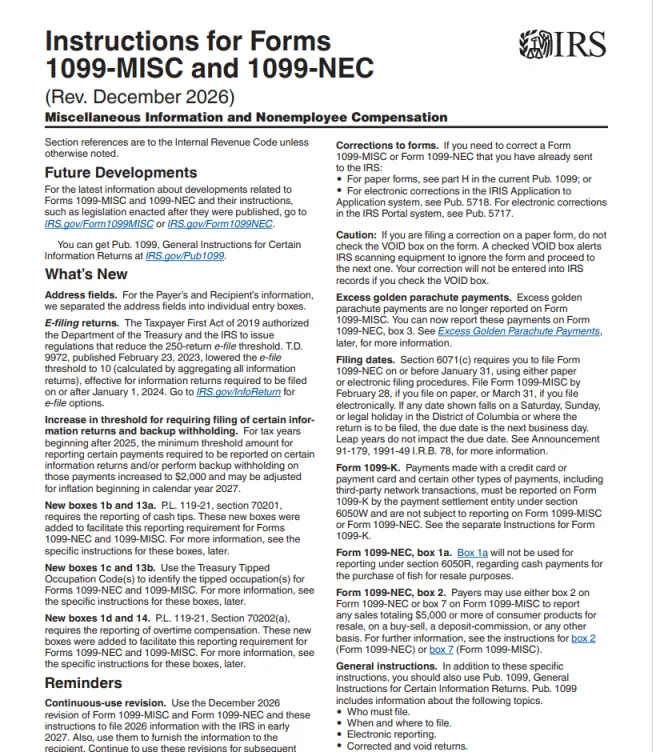
IRS Instructions for Forms 1099-MISC and 1099-NEC, "What's New." Screenshot captured October 1, 2026.
Two catches. A platform "may still send a Form 1099-K" below the threshold, and the IRS notes "your state may have a lower reporting threshold." None of these thresholds change what you owe.
How Do You Report FeetFinder Income on Your Taxes?
Most US sellers report FeetFinder sales as sole proprietor income on Schedule C, then figure self-employment tax on Schedule SE, and carry both to Form 1040. The IRS says gig workers who get a 1099-K "should report Form 1099-K payment information on" Schedule C.
Pull your FeetFinder sales history for the calendar year (January 1 to December 31). Your own records are the starting point, not the 1099.
Collect any 1099 from Segpay and check the name, TIN and amount.
Fill in Schedule C (Form 1040). Enter your gross receipts, then list expenses such as the FeetFinder service fee and seller plan. The IRS says the 1099-K gross amount "isn't adjusted for any" fees or refunds, and you can deduct those items. Match your figures to whatever amount the form shows so nothing is counted twice or missed.
Complete Schedule SE if your net earnings from self-employment are $400 or more.
Move the totals to Form 1040. Schedule SE line 13 gives you a "Deduction for one-half of self-employment tax."
Check your state. Many states also tax this income, with their own forms and rules.
Calendar-year filers normally file by April 15, so 2026 returns are due April 15, 2027. If you requested an extension for your 2025 return, the IRS gives you "until October 15" to file, which is October 15, 2026. Forgot to report FeetFinder income in an earlier year?
The IRS points gig workers to Form 1040-X, the amended return.
How Much Self-Employment Tax Do FeetFinder Sellers Pay?
The self-employment tax rate is 15.3%, applied to 92.35% of your net profit once net earnings reach $400. It is on top of regular income tax.
The IRS self-employment tax page says the 15.3% "consists of two parts: 12.4% for social security (old-age, survivors, and disability insurance) and 2.9% for Medicare (hospital insurance)."
You must file Schedule SE if "your net earnings from self-employment (excluding church employee income) were $400 or more."
92.35% rule: Schedule SE line 4a multiplies net profit "by 92.35% (0.9235)" before the 15.3% applies.
Half is deductible: you can deduct "the employer-equivalent portion" of SE tax when figuring adjusted gross income.
Social Security cap: the 12.4% part stops at an annual earnings cap. It was $176,100 for 2025, per the 2025 Schedule SE.
Extra Medicare: an additional 0.9% Medicare tax applies above $200,000 for single or head of household filers, $250,000 married filing jointly and $125,000 married filing separately. Wages count toward these thresholds.
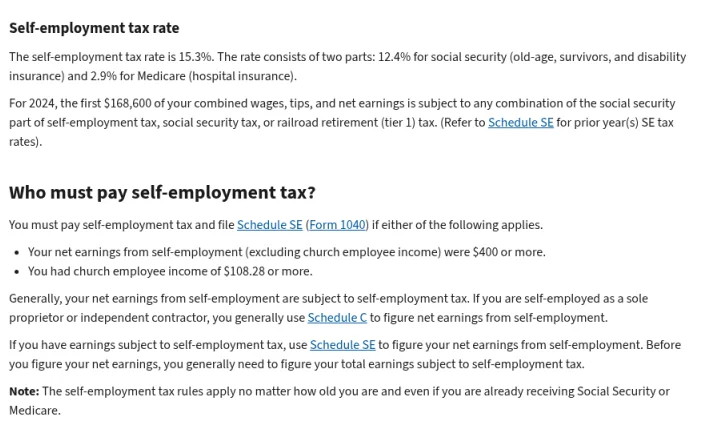
IRS.gov, "Self-employment tax (Social Security and Medicare taxes)." Screenshot captured October 1, 2026.
How Much Tax Would You Pay on $6,000 of FeetFinder Sales?
In our worked example, the seller owes about $1,192 in extra federal tax, or roughly 25% of net profit. Your own number depends on your bracket, expenses and state.
Example: a single US seller on FeetFinder's Basic plan makes $6,000 in gross sales during 2026 and has a W-2 job that puts her in the 12% federal bracket. The numbers below are a simplified illustration, not typical earnings.
Example line | Amount | How it is figured |
|---|---|---|
Example: gross FeetFinder sales | $6,000.00 | Total buyer payments for the year |
Example: FeetFinder service fee | minus $900.00 | 15% service fee on the Basic plan (you keep 85%) |
Example: Basic plan, annual | minus $14.99 | FeetFinder FAQ price for the annual Basic plan |
Example: props, socks and nail supplies | minus $285.00 | Receipts kept for business use |
Example: ring light | minus $85.00 | Used for shoots |
Example: net profit (Schedule C) | $4,715.01 | Gross minus expenses |
Example: SE tax base | $4,354.31 | $4,715.01 x 92.35% |
Example: self-employment tax | $666.21 | $4,354.31 x 15.3% |
Example: deduction for half of SE tax | $333.11 | $666.21 / 2 |
Example: added federal income tax | about $525.83 | ($4,715.01 minus $333.11) x 12%, simplified |
Example: total extra federal tax | about $1,192.04 | About 25% of net profit |
In this example, the seller owes about $1,192 in extra federal tax. That is over $1,000, so she generally needs estimated payments unless her paycheck withholding already meets the safe harbor explained below. She could pay quarterly or raise the withholding at her day job.
The example skips state tax, the qualified business income deduction and other credits, which can move the final number either way.
What Expenses Can FeetFinder Sellers Deduct?
You can deduct business costs that are "both ordinary and necessary," which lowers both income tax and self-employment tax. IRS Publication 334 defines an ordinary expense as "common and accepted in your field of business" and a necessary one as "helpful and appropriate for your business."
Expense | Usually deductible? | Notes |
|---|---|---|
FeetFinder service fee | Yes | 15% on Basic, 10% on Premium (you keep 85% or 90%) |
FeetFinder seller plan | Yes | Basic is $4.99 monthly, $14.99 annually or $40.00 lifetime; Premium is $14.99, $49.99 or $80.00, per FeetFinder's FAQ |
Props, socks, shoes and backdrops used for content | Yes, if bought for the business | Keep receipts and note what each item was used for |
Camera, ring light, tripod | Yes, business-use share | Equipment is often capitalized, but Pub 334's de minimis safe harbor can allow items up to $2,500 per item or invoice |
Phone and internet | Partly | Only the business-use percentage, not personal use |
Shipping and packaging for worn items | Yes | Keep postage receipts |
Bank fees on a business account | Yes | Listed in Pub 334 under "Other Expenses You Can Deduct" |
Home office | Only if strict rules are met | Needs "regular and exclusive use"; simplified method is $5 per square foot, up to 300 square feet |
Tax preparer or accountant fees | Yes, business portion | Pub 334 allows fees "directly related to operating your business" |
Pedicures, lotion and everyday clothing | Usually no | Publication 334 lists "Personal, living, and family expenses" among costs you "usually can't deduct." Items used only for shoots may differ, so ask a tax professional |
Keep a simple spreadsheet with dates, amounts and business purpose, plus photos of receipts. The IRS says good records "can help you track your income, deduct expenses and complete your tax return."
Do FeetFinder Sellers Need to Pay Quarterly Estimated Taxes?
Usually, yes. The IRS says individuals, including sole proprietors, "generally have to make estimated tax payments if they expect to owe tax of $1,000 or more when their return is filed."
Payment | Income earned | 2026 due date |
|---|---|---|
1st | January 1 to March 31 | April 15, 2026 |
2nd | April 1 to May 31 | June 15, 2026 |
3rd | June 1 to August 31 | September 15, 2026 |
4th | September 1 to December 31 | January 15, 2027 |
As of October 1, 2026, the next payment is due January 15, 2027.
Form 1040-ES (2026) says you can skip that payment "if you file your 2026 tax return by February 1, 2027, and pay the entire balance due with your return."
The form adds a safe harbor: you generally must pay only if you expect to owe at least $1,000 after withholding and refundable credits, and those will cover less than the smaller of "90% of the tax to be shown on your 2026 tax return" or "100% of the tax shown on your 2025 tax return."
That 100% becomes 110% if your 2025 adjusted gross income was over $150,000 ($75,000 if married filing separately). If you also have a paycheck, you can file a new Form W-4 and have more tax withheld instead.
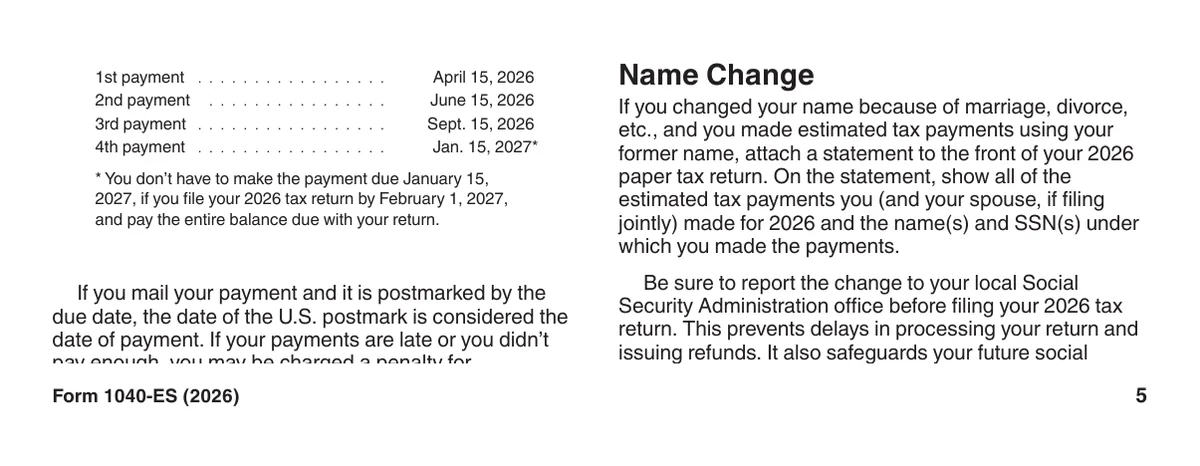
IRS Form 1040-ES (2026), "Payment Due Dates," page 5. Screenshot captured October 1, 2026.
Does FeetFinder Withhold Taxes From Payouts?
Normally, no. FeetFinder's Seller Agreement says it is not responsible for withholding income tax, so plan to pay the whole bill yourself. It does keep the right to withhold where "US tax law" requires it.
One case where withholding can happen is backup withholding.
The IRS backup withholding page says a payer may have to withhold "at the current rate of 24 percent" if you "failed to provide a correct taxpayer identification number." Filling in your W-9 correctly at sign-up avoids that.
Here is how FeetFinder payouts work, per its FAQ and Seller Agreement as of October 1, 2026:
US sellers: paid through Segpay, with "no need to create a separate Segpay account."
Sellers outside the US: "a Paxum account is required."
Masspay: an extra option "with payouts conveniently released every Tuesday."
Minimum: "We have a $30 minimum amount for payout requests," released "within 3-5 business days" after admin approval.
Currency: "All Buyer Payments and Seller Earnings are transacted in US dollars," and your bank or e-wallet may charge its own fees.
Want the full picture on fees, payouts and safety before you join?
Read our FeetFinder review.
For realistic pricing, see how much feet pics sell for, and for the step-by-step basics, see how to make money selling feet pics.
Get started on FeetFinder
What If You Sell on FeetFinder From Outside the US?
You follow your own country's tax rules, not the US rules on this page. FeetFinder's Seller Agreement says sellers outside the US "must submit a completed W-8BEN Form," and its FAQ says you are "responsible for filing your taxes in accordance with your countries tax laws."
UK sellers should start with the UK guide linked at the top of this page, which covers Self Assessment and the £1,000 trading allowance.
If you are still choosing a platform, compare the best sites to sell feet pics and our wider list of the best foot fetish websites. Other platforms such as OnlyFans, Fansly and FunWithFeet have their own payout and tax-form processes, so check each one separately.
FeetFinder Taxes FAQ
FeetFinder Taxes Checklist
Keep this list handy from your first sale.
For everything else about getting started, see our sell feet pics hub.
Submit an accurate W-9 when you register as a US seller.
Track every sale and every expense from day one.
Set money aside from each payout. In our example, federal tax came to about 25% of profit.
Pay estimated taxes if you expect to owe $1,000 or more and withholding won't meet the safe harbor. The next 2026 due date is January 15, 2027.
Look for a 1099 from Segpay in January, and report your income even if none arrives.
File Schedule C and Schedule SE with your Form 1040 by April 15, 2027 for tax year 2026.
Related guides

Written by
Lena Voss
Lena Voss reviews adult dating, cam, and platform sites for SpicyRanked. Her goal is simple: help you decide if a site is worth paying for before you hand over your card. She reads the billing terms and cancellation policy first, because that is where these platforms hide the costs. Her reviews cover the things that matter most, real prices, pushy upsells, whether the user numbers are honest, and how each site protects your privacy. When a platform is good, she says so. When it is not, she tells you plainly. No hype, just a clear answer you can trust.